
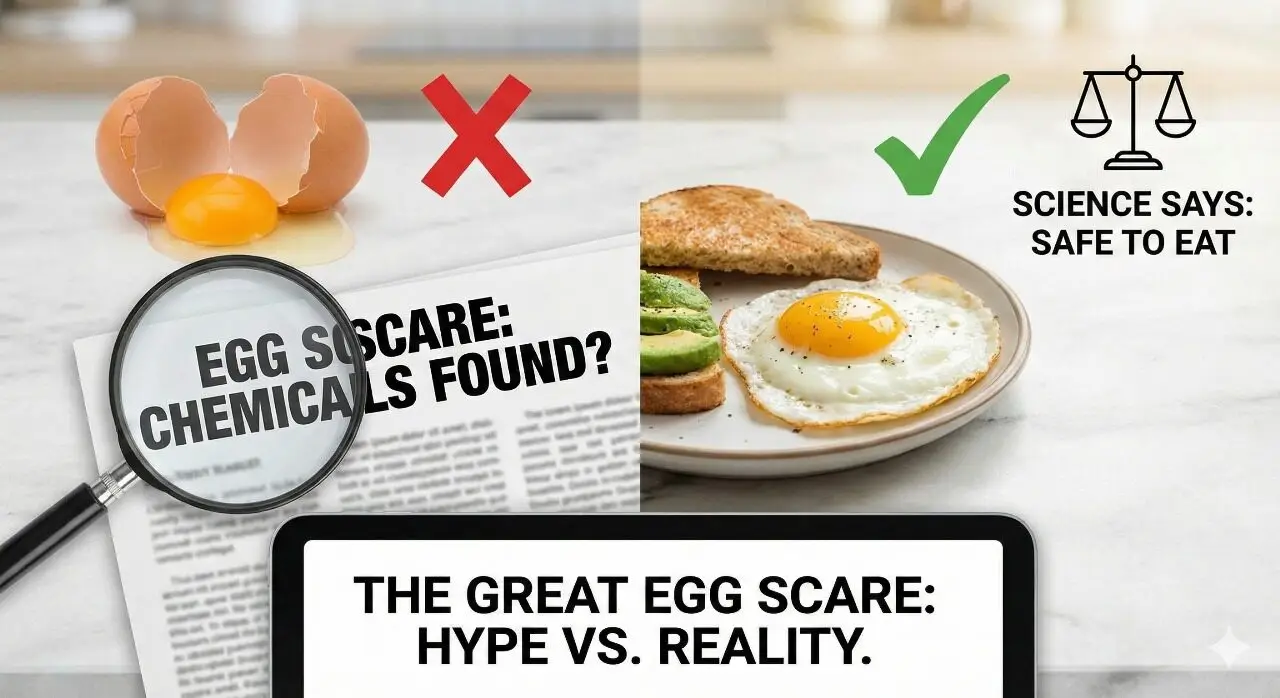
Do Eggs Cause Cancer? It seems like every other week, the internet finds a new superfood to villainize. One day coffee is the elixir of life; the next, it’s a health hazard. But recently, a specific food staple has landed in the hot seat, causing panic in family group chats and breakfast tables everywhere: Eggs.
If you’ve been scrolling through social media lately, you might have stumbled upon viral reports claiming that certain “premium” eggs contain cancer-causing chemicals. The headlines are terrifying. “Eggs Cause Cancer!” “Stop Eating Eggs Immediately!”
But before you throw out that crate of eggs sitting in your fridge, let’s take a deep breath. We need to separate the sensationalism from the science. Is your morning omelet really a ticking time bomb? Or is this another case of internet fear-mongering gone wrong?
In this deep dive, we are going to unpack the recent controversy involving independent lab tests, “antibiotic-free” claims, and a scary-sounding chemical called AOZ. We will look at the numbers, the regulations, and what the science actually says—without the hype.
What’s the Real Deal with Eggs?
- What Happened?
- The Scary Words(The main Culprit) : What Exactly are Nitrofurans and That Chemical, AOZ?
- The Math Matters : The Numbers Game: Understanding the Difference Between Tiny Micrograms and Big Milligrams.
- Who Makes the Rules? Local vs standards.
- The “Antibiotic-Free” Lie : How Did Companies Break Our Trust?
- Don’t Forget the Good Stuff : Reminder of Why Eggs Are Actually Superfoods.
- Now What Do I Do? Eating Eggs Safely and stress free.
- Conclusion
Table of Contents
1. What Happened?
The controversy started when independent consumer watchdogs decided to test popular, premium egg brands sold in the market. These are the brands that market themselves heavily on being healthy, herbal, and, crucially, antibiotic-free.
Samples were sent to certified laboratories for blind testing. The results were shocking for many consumers. The reports found traces of a metabolite called AOZ (3-amino-2-oxazolidinone).
The Viral Reaction
As soon as the findings were released, the information spread like wildfire. Doctors, fitness coaches, and concerned citizens started reacting. The core of the panic wasn’t just that a chemical was found, but that it was found in expensive brands that explicitly claimed to be free of such nasties.
It felt like a betrayal. You pay extra for safety, and you get… chemicals? But does finding a trace of a chemical equate to getting cancer? That’s where things get nuanced, and where we need to look closer at the actual data.

2.The main Culprit (scary part) : What Exactly are Nitrofurans and That Chemical, AOZ?
To understand the risk, we have to understand what was actually found in these eggs. The labs detected AOZ, which is a metabolite (a breakdown product) of a group of antibiotics called Nitrofurans.
Why are they used?
In the commercial poultry industry, keeping chickens healthy in crowded conditions is tough. Historically, some farmers used Nitrofurans to prevent bacterial infections and stimulate growth. Essentially, they helped chickens survive difficult conditions and lay more eggs.
Why are they banned?
Nitrofurans are classified as genotoxic and carcinogenic. In plain English: they can potentially damage your DNA and cause cancer. Because of this, they are banned for use in food-producing animals in the USA, the European Union, and in many other regions including India.
The scary part is that these antibiotics don’t just disappear after the chicken eats them. They leave behind “residues” or “metabolites” like AOZ that can linger in the tissue of the bird and the eggs they lay.
3.The Numbers Game (Math Matters): Micrograms vs. Milligrams
Here is where we need to put down the pitchforks and pick up a calculator. This is the most crucial part of the story that the fear-mongering headlines often ignore.
The Dose Makes the Poison.
The recent lab reports generally found AOZ levels at approximately 0.73 micrograms (mcg) per kilogram.
Is that a lot? Let’s look at the math.
The Safety Limit (BMDL10)
Scientists use a metric called BMDL10 (Benchmark Dose Lower Confidence Limit). This represents the dose at which there is a 10% increase in tumor risk in animal studies.
- The critical limit for these compounds is roughly 1.6 milligrams (mg) per kg of body weight per day.
The Unit Confusion
This is where people get confused:
- Milligrams (mg) vs. Micrograms (mcg).
- 1 Milligram = 1,000 Micrograms.
The amount found in the eggs was in micrograms (fractions of a milligram). The dangerous dose is in milligrams.
The Real-World Math
If you weigh 70kg, and you eat an egg (approx. 50g), the amount of AOZ you are ingesting is microscopic—around 37 nanograms.
To reach a level where you are even remotely approaching the toxicity limits seen in animal studies, you would need to eat an astronomical amount of eggs.
- Calculations show you would likely need to eat roughly 175 to 200 eggs every single day for your entire life to hit a risk threshold that is still significantly lower than the direct toxic dose.
The Verdict: While the substance is carcinogenic by classification, the amount present in these eggs is so infinitesimally small that the immediate cancer risk to a human being eating 2-3 eggs a day is virtually non-existent. You are likely exposed to more carcinogens walking down a busy street and inhaling traffic fumes than you are from these eggs.
4.Who Makes the Rules? Local vs standards.
If the risk is so low, why is there such an uproar? This brings us to the complex world of Regulatory Standards.
The “Zero Tolerance” Policy
In countries like the USA, Canada, Australia, and across the EU, there is a strict Zero Tolerance policy for Nitrofurans.
- It doesn’t matter if the risk is low.
- It doesn’t matter if you need to eat 500 eggs to get sick.
- If modern lab technology can detect it, it is illegal. Period.
Why? Because these countries argue that for genotoxic carcinogens, no level is technically “safe,” and strict enforcement prevents farmers from cheating the system.
The Local Scenario
In many developing markets, including India, the actionable limits set by food safety authorities can be different.
- Sometimes, the “actionable limit” is set higher because older testing methods couldn’t detect such tiny amounts.
- Since the levels found (0.73 mcg/kg) were incredibly low, these eggs technically passed or fell into a grey area under local enforcement norms, even if they would have failed in Europe.
The Discrepancy: Technology has advanced. Years ago, labs couldn’t detect 0.73 mcg. Now they can. While global standards updated to say “if we can see it, it’s banned,” local standards sometimes lag behind, allowing for a margin that technically lets these products slip through as “safe.” This creates a double standard that angers health advocates.
5.The “Antibiotic-Free” Lie : How Did Companies Break Our Trust?
The biggest issue here isn’t necessarily cancer; it’s integrity.
Many premium egg brands charge a much higher price than standard eggs. You pay double or triple the cost because the box makes bold claims:
- Herbal Feed
- No Antibiotics
- Farm Fresh & Pure
When a lab test reveals traces of a banned antibiotic, the brand has broken a promise. Even if the level is too low to kill you, the fact that it is there at all suggests:
- The birds were likely given antibiotics at some point.
- The feed was contaminated.
- The “quality checks” the brand boasts about are not stringent enough.
Using these drugs to boost production is a shortcut. When you pay for premium, you expect purity. Discovering that your “antibiotic-free” eggs have antibiotic residues is like buying a vegetarian meal and finding a tiny piece of meat in it. It might not harm your health significantly, but it’s definitely not what you paid for.
6. Don’t Forget the Good Stuff : Reminder of Why Eggs Are Actually Superfoods.
Amidst the panic, it is vital not to lose sight of the big picture. Eggs are, nutritionally speaking, a powerhouse.
If you stop eating eggs because of a 0.000001% theoretical risk, you are missing out on incredible health benefits:
- High-Quality Protein: Eggs provide the gold standard of protein for muscle repair and growth.
- Choline: Essential for brain health and cell function.
- Healthy Fats: Necessary for hormone production and nutrient absorption.
- Vitamins: Rich in B12, D, and A.
Many observational studies linking eggs to health issues are often flawed. They rely on people remembering what they ate years ago and don’t account for lifestyle factors (like if the person also smokes or doesn’t exercise).
Abandoning a nutrient-dense whole food because of a trace contaminant—while continuing to eat processed foods, sugar, and breathe polluted air—is a classic case of misplaced anxiety.

7.Now, What Do I Do? Eating Eggs Safely and stress free.
So, you don’t want to stop eating eggs, but you’re rightfully annoyed about the chemicals. What should you do? Here are some practical, human-friendly tips.
Don’t Put All Your Eggs in One Basket (Literally)
The best strategy for any diet is Rotation. Don’t get your protein only from eggs. And don’t buy eggs only from one specific brand.
- One week, buy Brand A.
- Next week, buy from a local farmer or a different brand.
- The week after, try a different protein source entirely.
- Mix in paneer, chicken, tofu, whey, and lentils.
By diversifying, you dilute the risk. If one batch from one company has a bad compound, you aren’t accumulating it in your body every single day.
Know Your Source
If you can, find a local poultry farm or a smaller supplier. Smaller, local farms often have less need for aggressive industrial antibiotic use compared to massive commercial operations. Ask them what they feed their chickens.
Cook Your Eggs Well
While cooking doesn’t eliminate all chemical residues, it does destroy harmful bacteria like Salmonella. Hard-boiling or scrambling is generally safer than consuming raw eggs.
Be Skeptical of Marketing
Just because a box says “Herbal” or “Organic” doesn’t always mean it’s perfect. Marketing claims are designed to sell. Look for transparency, such as brands that publish their own lab reports regularly.
8.Conclusion
Let’s circle back to the burning question: Do eggs cause cancer?
The short answer is NO. Eating eggs, even the ones involved in recent controversies, is not going to give you cancer tomorrow or likely ever. The levels of the toxic compound found are millions of times lower than what is considered immediately dangerous.
However, the moral answer is complicated. The presence of banned antibiotics in premium eggs is a wake-up call. It highlights a system where marketing claims sometimes write checks that quality control can’t cash.
Your Takeaway:
- Don’t panic. Your breakfast is safe.
- Be smart. “Premium” labels don’t always guarantee perfection.
- Diversify. Rotate your foods to minimize risk from any single source.
- Stay informed. Pay attention to independent testing, but always look at the actual numbers before giving in to fear.
Food safety is a journey, not a destination. While we wait for regulations to tighten and brands to be more honest, common sense is your best defense. Keep eating your eggs, stay healthy, and maybe… just maybe… don’t believe every scary headline you see without checking the math first.







1 thought on “Do Eggs Cause Cancer? The Truth Behind the Viral “Antibiotic” Panic”