For decades, the debate has raged in tea stalls and office breakrooms across India: is this a cricket nation or a sports nation? In December 2025, that question was momentarily silenced, not by a wicket or a six, but by the arrival of a diminutive Argentine with magic in his boots.
Lionel Messi, the man who completed football in Qatar in 2022, finally returned to Indian soil. While his visit began with a chaotic frenzy in Kolkata, it was the legs in Hyderabad and Mumbai that truly defined the GOAT India Tour 2025. From the historic streets of the Deccan to the glittering coastline of the Arabian Sea, Messi’s journey was more than a PR event; it was a cultural pilgrimage.
This blog creates a definitive account of those 48 hours where India paused to breathe in the same air as the greatest footballer of all time. We dive deep into the hysteria of Hyderabad, the glamour of Mumbai, and that earth-shattering moment when the God of Cricket met the God of Football.
Table of Contents
Hyderabad Hails the King – The Calm After the Kolkata Storm
After a turbulent start in Kolkata, where passion boiled over into mismanagement, all eyes turned to Hyderabad. The city of Nizams, known for its rich history and biryani, had a massive point to prove: they could host the King with the dignity he deserved.
The Arrival: A Royal Welcome in the Deccan
On December 13, 2025, the atmosphere at the Rajiv Gandhi International Airport was electric but controlled. Unlike the frantic scenes in West Bengal, Hyderabad offered a disciplined adoration. Thousands of fans, draped in the iconic La Albiceleste stripes, lined the streets leading to the city center.
The Telangana government, determined to showcase the state’s prowess in hosting global icons, had turned the city into a fortress of celebration. Giant cutouts of Messi adorned the path to the hotel, rivalling the size of those usually reserved for Tollywood superstars.
The Main Event: Magic at Rajiv Gandhi International Stadium
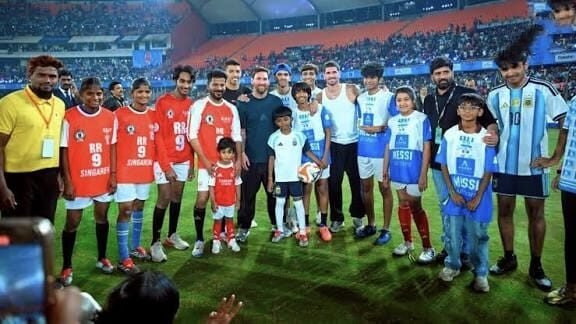
The highlight of the Hyderabad leg was the event at the Rajiv Gandhi International Cricket Stadium. Traditionally a fortress for the Sunrisers Hyderabad, for one night, the pitch was transformed for the beautiful game.
1. The Exhibition Match
Messi took to the field for a 7-a-side exhibition match. The roar that erupted when he jogged onto the turf reportedly registered on local seismographs. Unlike the distant waves in Kolkata, fans here saw Messi play. He wasn’t just a showpiece; he was a participant.
- The Teams: The match featured a mix of local talent, young academy players, and a few lucky celebrities.
- The Moment: In the 15th minute, Messi received a ball near the center, dropped a shoulder to ghost past a defender, and casually rolled a pass that split the defense. He didn’t score, but he didn’t need to. The touch was enough.
2. Political Heavyweights and unexpected bonds
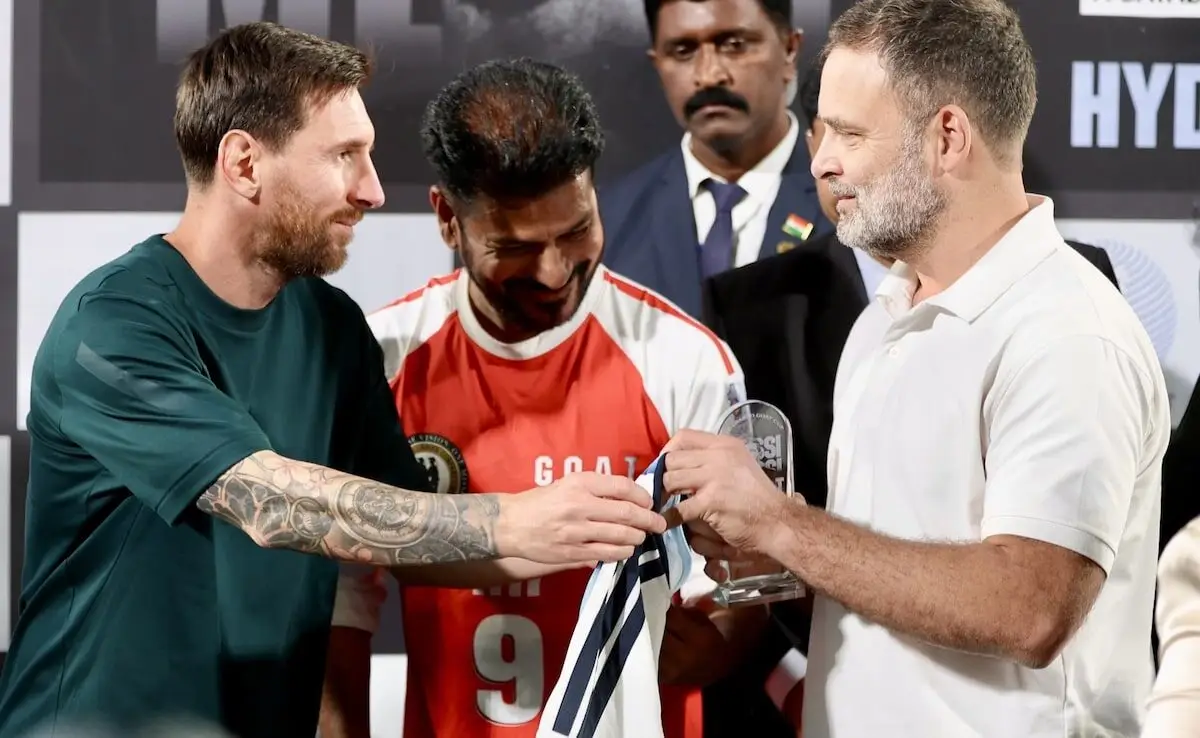
The event was attended by Telangana Chief Minister Revanth Reddy and Congress leader Rahul Gandhi. In a moment that went viral instantly, Messi presented his signed Number 10 Argentina jersey to Rahul Gandhi, while the CM felicitated the star. It was a fascinating intersection of sports and politics, yet for the fans in the stands—chanting “Messi! Messi!”—politics was the last thing on their minds.
3. Heartwarming Interactions
Perhaps the most touching moment of the Hyderabad leg was Messi’s interaction with the children. A group of young footballers from local academies were allowed onto the pitch. The world saw the “human” side of the deity as he juggled the ball with awe-struck 10-year-olds, high-fiving them with the same grin he wore when lifting the World Cup.
Hyderabad Verdict: The city succeeded where others stumbled. They gave Messi respect, space, and a platform to be a footballer, not just a celebrity.
Mumbai – Where Stars Aligned and Gods Met
If Hyderabad was about respect, Mumbai was about spectacle. On December 14, 2025, the tour moved to the financial capital. Mumbai is a city that isn’t easily star-struck—it is the home of Bollywood and the headquarters of Indian cricket, after all. But Messi is different.
The Padel Tennis Surprise at CCI
The itinerary threw a curveball with a stop at the Cricket Club of India (CCI) at Brabourne Stadium. Here, Messi didn’t play football; he played Padel—a racquet sport gaining massive popularity globally.
- The Vibe: Exclusive, elite, and intimate. The historic club, usually reserved for the city’s crème de la crème, was packed.
- The Significance: Watching Messi play a different sport showcased his natural athleticism. It also allowed a different demographic of fans—the Mumbai elite—to engage with him in a relaxed setting.
The Wankhede Spectacle: hallowed Ground, New God
The true climax of the India tour took place at the Wankhede Stadium. This venue is holy ground for Indian sports fans; it is where India won the 2011 Cricket World Cup.
The scenes outside Wankhede were reminiscent of a World Cup final. Marine Drive was a sea of blue and white. Vendors sold Messi masks, flags, and replicas of the World Cup trophy.
The “Sachin x Messi” Moment
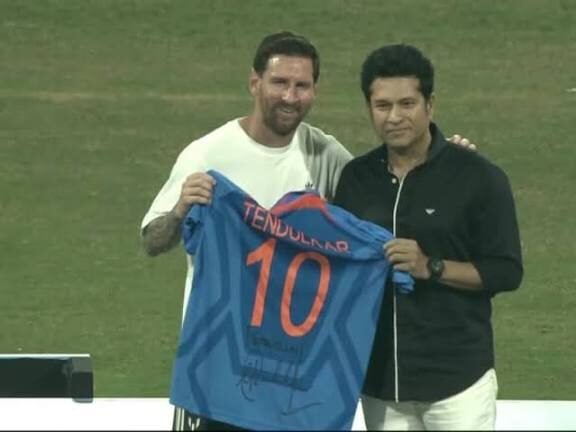
Then happened the moment that broke the Indian internet. Sachin Tendulkar, the God of Cricket, walked out to meet Lionel Messi, the God of Football.
- The Exchange: In a beautifully scripted yet genuine moment, Tendulkar presented Messi with a signed India cricket jersey (Number 10, naturally), and Messi handed Tendulkar a signed Argentina kit.
- The Symbolism: This wasn’t just a photo op. It was a meeting of two men who carried the expectations of a billion people (or 45 million Argentines) on their shoulders for decades. The mutual respect was palpable. Tendulkar, speaking to the crowd, welcomed Messi to the “City of Dreams,” acknowledging the similar burdens they had both borne.
The Captain Meets The G.O.A.T : Messi x Chhetri
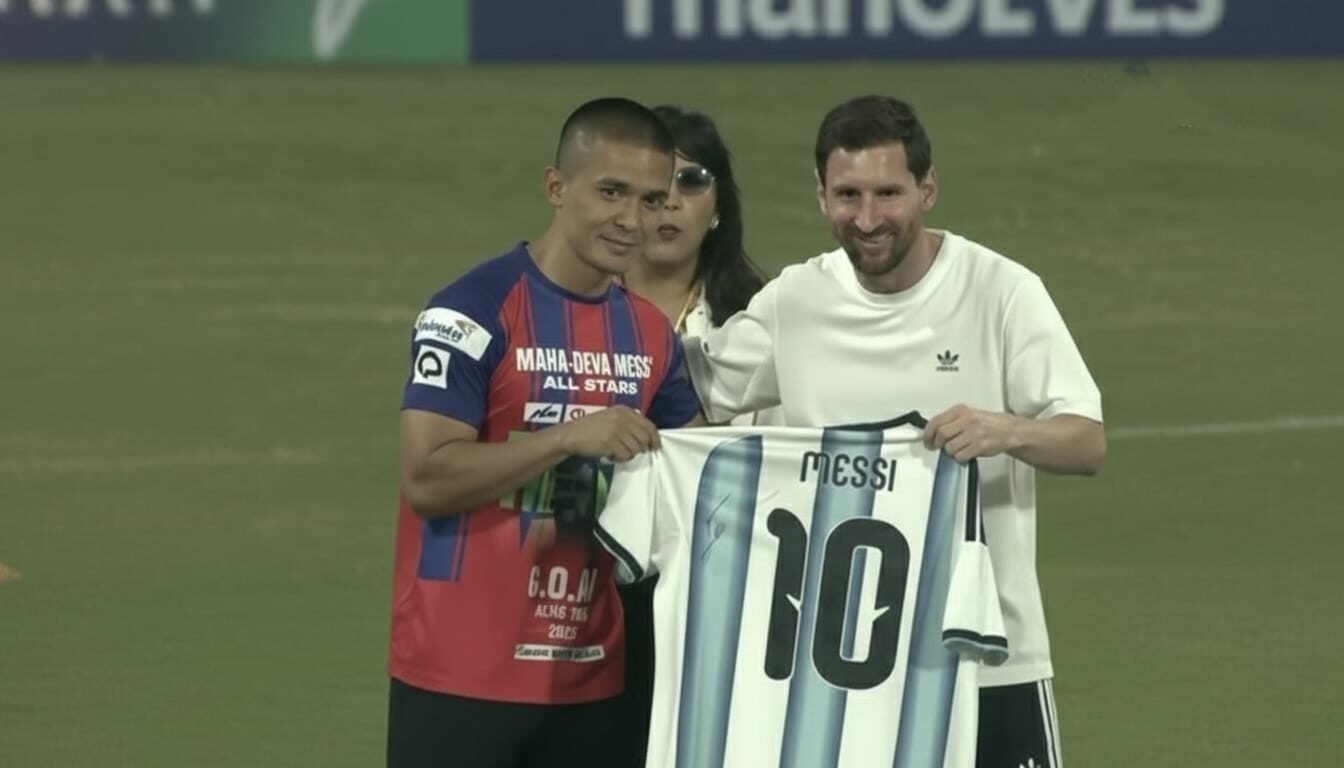
The most significant moment for the future of Indian football occurred just moments before the exhibition match. Sunil Chhetri, the Captain of the Indian National Football Team (The Blue Tigers) and the third-highest active international goalscorer in the world, was brought onto the pitch to a hero’s welcome.
- The Setting: Standing on the Wankhede turf, a pitch he has only occasionally stepped on, Chhetri looked visibly moved. The crowd cheered for their homegrown hero just as loudly as they did for the Argentine.
- The Conversation: The two captains—one for Argentina, one for India—shared a quiet, respectful moment. Chhetri presented Messi with the official jersey of the Blue Tigers, a symbolic handover of the nation’s passion. Messi, in turn, signed a match ball specifically for the Indian captain.
- The Impact: In a brief post-meeting interview, a beaming Chhetri stated, “The noise he generated tonight isn’t for an individual; it’s for the sport. It proves that football is alive and kicking in India. For any young Indian striker, this is a reminder of the standard we must aim for.” This interaction instantly legitimized the tour in the eyes of hardcore Indian football fans, showing respect between the global elite and India’s greatest.
The Bollywood factor
Mumbai cannot host an event without Bollywood. The stands were peppered with A-listers. Ranbir Kapoor, a known football fanatic and owner of Mumbai City FC, was seen visibly emotional near the dugout. Shah Rukh Khan, who had already met Messi in Kolkata, was present in spirit through the thunderous cheers of his home city.
The exhibition match here was a glitzy affair. Unlike the grassroots feel of Hyderabad, this was high production value. Messi played for 20 minutes, wowing the crowd with his vision. Every time he touched the ball, the famous Wankhede roar—usually reserved for a boundary—echoed through South Mumbai.
Why This Visit Matters for Indian Football
Beyond the selfies, the VIP movement, and the ticket sales, what does Messi’s visit to Hyderabad and Mumbai actually mean for India?
1. The Sleeping Giant Wakes Up
FIFA has long called India the “sleeping giant” of football. Messi’s visit proved that the giant isn’t sleeping; it’s just starving. The passion seen in Hyderabad and Mumbai showed that the demand for high-quality football is voracious.
- Hyderabad’s case: The disciplined turnout proved that non-traditional football hubs (unlike Kolkata or Kerala) are ready for big events.
- Mumbai’s case: The commercial success at Wankhede showed that football is a viable, lucrative business in India’s richest city.
2. Inspiration for the “Blue Tigers”
For the young kids who shared the turf with Messi in Hyderabad, life has changed forever. Seeing the global pinnacle of the sport in the flesh makes the dream tangible. It bridges the gap between watching a pixelated figure on TV at 2 AM and realizing that he is a real human being who works hard. This visit will likely spur a spike in academy enrollments across Telangana and Maharashtra.
3. Infrastructure Reality Check
While the events were successful, they also highlighted the need for football-specific stadiums. Playing in cricket stadiums (Rajiv Gandhi and Wankhede) is a makeshift solution. For India to truly host global football events, we need world-class football arenas in cities like Mumbai and Hyderabad.
Conclusion: The Legacy of Number 10
As Lionel Messi flew out of Mumbai, heading to his final stop in Delhi, he left behind more than just memories. He left a validation.For the fan in Hyderabad who rode a bike for 200 kilometers to see him, and for the fan in Mumbai who spent a month’s salary on a Wankhede ticket, this was closure. They had seen the man who defined their childhoods, their teenage years, and their adult lives.
The 2025 tour will go down in history not because of the goals scored in exhibition matches, but because it was the year India showed the world that it doesn’t just worship cricketers. In the land of Sachin, there is a massive throne for Messi too.
For Hyderabad and Mumbai, the 13th and 14th of December 2025 will forever remain the days the world stopped spinning, and the ball started rolling.