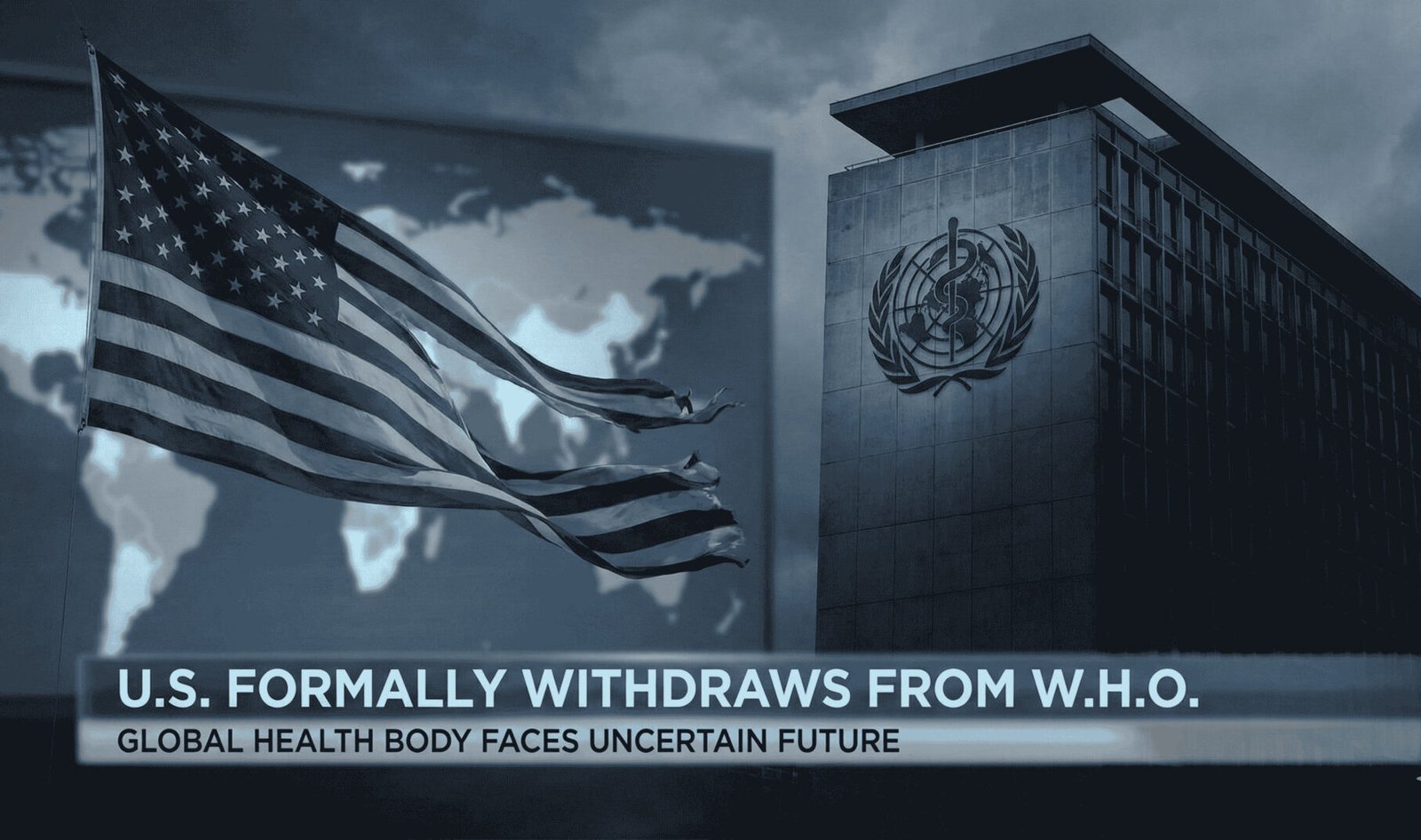
In a move that is reverberating across the globe, the United States formally completed its withdrawal from the World Health Organization (WHO) on January 22, 2026, marking an unprecedented moment in international public health history. After nearly eight decades of participation as a founding member, the U.S. is no longer part of the United Nations’ global health agency — a decision that has generated fierce debate, uncertainty, and deep concern among health experts, diplomats, and world leaders.
This development is not just another headline — it represents a pivotal shift in how one of the world’s most powerful nations views international collaboration on health threats. Below, we unpack the background, the official reasons cited by U.S. leaders, the response from the WHO and global health experts, and what this could mean for the future of global disease preparedness.
Table of Contents
A Break from History: How the Withdrawal Unfolded
For nearly 80 years, the United States played a central role in the World Health Organization. From helping to establish the organization in 1948 to serving as one of its largest and most influential financial backers, American engagement was a cornerstone of global health diplomacy.
However, that long association came to an end on January 22, 2026, when the U.S. officially exited the WHO after a formal one-year notification period. This process was triggered by Executive Order 14155, signed by President Donald Trump on January 20, 2025, during his second inauguration day.
In a joint announcement by the U.S. Department of Health and Human Services (HHS) and the U.S. Department of State, American officials confirmed the completion of the withdrawal, stating that all membership, funding, and personnel involvement with the WHO had ended. The United States also signaled it would not participate as an observer nor does it plan to rejoin at this time.
Official Reasons: Government Critiques of WHO Leadership and Pandemic Response
The U.S. administration’s official justification for withdrawing centered on long-standing criticisms of the WHO’s handling of the COVID-19 pandemic and broader concerns about governance and political influence within the organization.
American leaders argued that the WHO:
- Delayed declaring a global health emergency in the early stages of the COVID-19 outbreak, costing critical time in response efforts around the world.
- Downplayed early pandemic risks, including asymptomatic transmission and potential airborne spread, according to U.S. officials.
- Failed to adopt meaningful reforms to prevent what Washington called “political influence” from member states on health decisions.
The CDC’s official statement claimed that the WHO had not demonstrated independence from national interests and that its pandemic evaluations — especially about the origins of the coronavirus — failed to uphold the scientific transparency that should drive global health responses.
In the U.S. government’s view, these failures justified not just a withdrawal but a reorientation of the country’s approach to international health cooperation, favoring direct bilateral engagement with other nations and non-governmental entities over participation in a centralized global body.
Outstanding Payments and a Troubled Departure
One of the more controversial aspects of the U.S. exit is the issue of unpaid dues.
Although the United States provided a one-year notice ahead of its withdrawal, the WHO states that Washington still owes more than $130 million in financial contributions for 2024 and 2025. These funds are part of the standard assessments and voluntary contributions that underpinned a large share of the organization’s budget.
This has added another layer of tension, as the WHO’s executive board prepares to address how to manage the departure and its financial implications.
Global Reaction: Unease, Criticism, and Calls for Continued Cooperation
The international response has been swift and, in many cases, sharply critical.
Health experts and global leaders have warned that the U.S. exit could destabilize efforts to monitor, prevent, and respond to infectious disease outbreaks worldwide. Dr. Ronald Nahass, president of the Infectious Diseases Society of America, described the move as “shortsighted and scientifically reckless,” noting that the departure might weaken critical systems for tracking viruses and coordinating vaccine strategies — including seasonal influenza forecasting.
Similarly, Lawrence Gostin, director of the WHO Collaborating Center on National and Global Health Law at Georgetown University, called the separation a “very messy divorce” that could slow global health progress and diminish American influence in key health decisions.
On the diplomatic front, the WHO itself expressed regret about the departure, emphasizing that health issues like infectious diseases, chronic health conditions, and emergency responses cross borders and require coordinated action. A United Nations spokesperson said that although some legal details remain to be resolved, the U.S. is “no longer participating in the work of the World Health Organization.”
Domestic and Regional Responses: States Step Up
Interestingly, not all American responses align with the federal government’s position. For instance, California announced it would independently join the WHO’s Global Outbreak Alert & Response Network (GOARN), becoming the first U.S. state to do so in the wake of the federal withdrawal. California’s governor criticized the decision to leave as “reckless” and harmful to both national and global health cooperation.
Such moves suggest that sub-national actors in the U.S. may continue to seek avenues for global health engagement, even as the federal government disengages from formal WHO structures.
What This Means for Global Health — and for the U.S.
The full implications of the U.S. withdrawal are still unfolding, but several key concerns have already been highlighted by public health professionals:
1. Loss of Leadership and Influence
The United States historically played a major role in shaping global health policy, setting priorities, and financing large-scale initiatives against diseases like polio, HIV/AIDS, and tuberculosis. Its absence leaves space for other nations to fill leadership roles, potentially shifting geopolitical dynamics within the WHO and wider UN systems.
2. Weaker Disease Surveillance Networks
By withdrawing from formal participation in WHO committees and surveillance systems, U.S. scientists and health agencies may lose access to real-time data on emerging health threats, including new pathogens or mutations of existing viruses. This could delay detection and response actions — both globally and domestically.
3. Funding and Operational Challenges for WHO
Without U.S. financial contributions, the WHO faces budget shortfalls that could force cuts to staffing, programs, and operational capacities — particularly in low- and middle-income countries that rely on WHO support for essential health services.
4. A New Era of Bilateral Health Partnerships
The U.S. government says it will pursue direct bilateral health partnerships and work through alternative multilateral platforms. While this may offer more targeted cooperation with specific countries, experts warn it cannot replace the broad coordinating role of a united global system when it comes to pandemic prevention and epidemic response.
Looking Ahead: Cooperation, Competition, or Fragmentation?
As the global community adjusts to this historic shift, several questions remain:
- Will the U.S. ever rejoin the WHO under a future administration?
- Can states, private health networks, and non-governmental actors fill the gap in global disease surveillance and emergency response?
- How will other nations react — will they strengthen ties with WHO or seek alternative alliances?
What is clear is that global health cooperation is entering a new chapter — one that underscores both the importance of international institutions and the challenges posed when major powers step away from collective efforts.
Final Thoughts
The United States’ official withdrawal from the World Health Organization represents far more than a political headline. It marks a turning point in how global health governance operates and raises urgent questions about preparedness, collaboration, and leadership in a world that has faced one pandemic after another in recent years.
Whether this decision ultimately strengthens U.S. health policy or leaves dangerous gaps in global readiness, the effects will be felt far beyond Washington and Geneva — in communities around the world that depend on early warning systems, coordinated responses, and shared scientific expertise to stay safe and healthy.