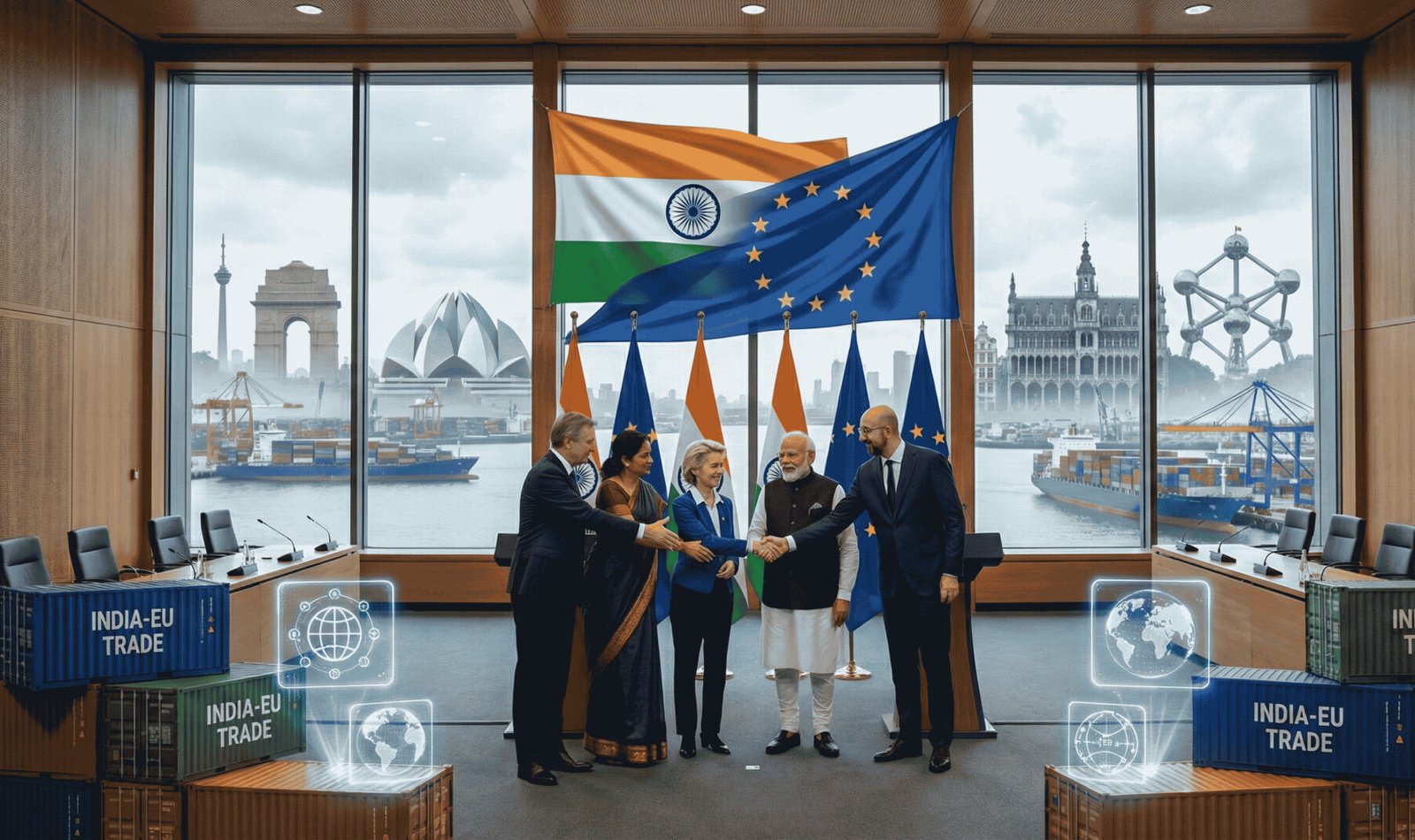
New Delhi, January 28, 2026 — In a sweeping breakthrough that investment analysts are calling the single most significant trade moment in decades, India and the European Union (EU) have announced the conclusion of a comprehensive Free Trade Agreement (FTA) — described by leaders on both sides as the “Mother of All Deals.” This agreement, the culmination of nearly 20 years of negotiations, promises to redraw global trade routes, expand economic opportunity for billions of people, and redefine India’s strategic posture in an era of geopolitical flux.
Table of Contents
1. A New Era in India-Europe Economic Relations
After years of periodic talks, compromises, and occasional diplomatic standoffs, India and the European Union have signed a landmark trade agreement that stands to open previously guarded markets on both sides. Primarily, the deal aims to eliminate or sharply reduce tariffs on a vast majority of traded goods and services, bolstering two-way commerce between India — one of the world’s fastest-growing major economies — and the EU, a highly integrated economic bloc of 27 nations representing more than 500 million consumers.
The FTA was formally agreed during the 16th India-EU Summit hosted in New Delhi on January 27, 2026, coinciding with India’s Republic Day celebrations, where senior EU leaders including European Commission President Ursula von der Leyen and European Council President António Costa were present alongside India’s Prime Minister Narendra Modi.
“This is not just a trade agreement — it’s a blueprint for shared prosperity,” Prime Minister Narendra Modi said during the joint press conference. “This deal will bring transformative opportunities to India’s 1.4 billion citizens and millions more across Europe.”
2. What the Deal Covers: Tariffs, Market Access & Strategic Sectors
Tariff Reductions Across Most Goods
One of the defining features of the agreement is its expansive tariff liberalization:
- Up to 97% of European exports to India will see tariffs eliminated or significantly reduced, saving European firms approximately €4 billion annually in duties.
- India will remove or cut tariffs on nearly 99% of Indian exports to the EU, including labour-intensive sectors such as textiles, apparel, leather, and gems & jewellery.
- Major European products — including machinery, chemicals, aircraft components, and electrical equipment — will benefit from improved market access.
While sensitive agricultural products such as dairy, rice, and sugar were largely excluded to protect domestic farmers in both regions, the pact nonetheless opens new possibilities for processed foods, textiles, and other labour-intensive Indian exports.
Automobiles and Consumer Goods: A Big Opening
The automobile sector — traditionally heavily protected in India — is a standout area of reform:
- Tariffs on imported European cars, previously as high as 110%, will be phased down to about 10% over a defined period under quota limitations that could allow up to 250,000 imported vehicles annually at preferential rates — six times larger than similar deals, such as the UK pact.
- India has also agreed to reduce tariffs on many consumer goods such as wines, spirits, and luxury items, creating easier access for European brands while stimulating competition in domestic markets.
At the same time, a notable temporary exclusion is in place for battery-electric vehicles (EVs), which will be protected from tariff reductions for the next five years to safeguard burgeoning Indian investments in EV manufacturing.
3. Strategic and Geopolitical Dimensions
A Shield Against Global Trade Tensions
The timing of the India-EU deal is significant. Global trade uncertainty has risen sharply in recent years, particularly due to protectionist policies in major economies. India has faced punitive tariffs — such as an additional 25% levy imposed by the U.S. in August 2025 — which have impacted its exports.
Against this backdrop, the EU-India FTA is seen not only as an economic pact but also as a strategic move to diversify supply chains and reduce overdependence on any single trade partner. Both India and the EU have signalled desires to hedge against geopolitical volatility — particularly amid shifting U.S. trade postures and rising tensions with China.
In addition, the two sides have agreed on a Security and Defence Partnership Framework, aimed at strengthening cooperation in counter-terrorism, cyber security, maritime security, and future defence supply chain integration — a significant step in shared strategic priorities.
4. How India’s Key Industries Stand to Benefit
Textiles, Leather, and Apparel
India’s textile and apparel sectors — among the largest employers and export drivers — are expected to see zero-duty access on most tariff lines to the EU market, potentially unlocking substantial new markets and enhancing export competitiveness.
Experts predict that this could increase India’s textile exports to the EU by double in less than a decade, leveraging India’s existing strengths in cotton, yarn, and value-added apparel production.
Gems and Jewellery Sector — A Boost in Global Trade
For India’s vast gems and jewellery industry — a major export category — the trade deal could be transformative. By removing customs duties of 2–4% on exported jewellery products, the industry expects its trade with the EU to double from current levels ($5.2 billion) to around $10 billion within three years. This would help balance losses the sector has faced due to U.S. tariffs and open new avenues for small and medium exporters.
Automotive and Manufacturing Expansion
European automakers who have historically held a small slice of India’s domestic market are now eyeing a significant expansion. Earlier restrictive tariffs limited European brands to just a sliver of India’s roughly 6 million units per year auto market. With the phased reductions, companies like Volkswagen, Renault, Mercedes-Benz, and BMW are expected to scale up regional operations and manufacturing collaborations.
5. Consumer Impact: From Luxury to Everyday Goods
While the deal is primarily economic in scope, ordinary citizens in both regions can expect some real effects — not just abstract GDP figures.
Lower Prices on Imported Goods
Reduced tariffs may translate into cheaper prices for imported European products in India — from machine tools and medical equipment to select consumer goods like wines, luxury accessories, and potentially even niche categories such as designer fragrances and machinery inputs.
Similarly, Indian electronics, apparel, leather goods, and marine products could become more competitive in EU markets, benefiting Indian exporters and, in turn, potentially leading to more jobs across manufacturing hubs.
6. Economic Forecast: What Analysts Are Saying
Economic commentators broadly view the FTA as a major positive for global trade, but they warn against excessive hype.
- According to analysts at the Atlantic Council, while the deal is important, it may not by itself revolutionize global trade dynamics, especially given exclusions of some agricultural products and other regulatory hurdles.
- Others note that the real economic effects will only become clear once national legislatures ratify the deal and it comes into force, likely in early 2027 pending legal review.
Yet even sceptical voices acknowledge that for economies as large and diverse as India and the EU, a trade zone encompassing nearly 2 billion people, about 25% of global GDP, and roughly one-third of all international trade represents a massive commercial ecosystem with long-term strategic value.
7. The Road Ahead — Implementation and Challenges
Ratification and “legal scrubbing” — the detailed review of the agreement text by legal and regulatory bodies on both sides — will likely take several months. The European Parliament and India’s cabinet will need to approve the final text before it enters into force, possibly by early 2027.
Agriculture and Regulatory Sensitivities
Negotiators deliberately set aside agriculture and certain sensitive sectors in this agreement, acknowledging the political and economic complexities involved. How these areas might be integrated over time remains an open question for future negotiations.
Carbon Tariffs and Compliance
Indian firms affected by the EU’s Carbon Border Adjustment Mechanism (CBAM) — a system aimed at imposing climate-related levies on carbon-intensive imports — did not receive blanket exemptions under the trade deal. Some flexibility provisions were discussed, but long-term compliance will need careful calibration by Indian industries.
8. A Historic Partnership in Modern Global Politics
At a time when global trade networks are under pressure from geopolitical rivalries, shifting alliances, and economic nationalism, the India-EU trade pact stands as a rare moment of cooperative ambition.
By bridging two democratic economic powerhouses — each with distinct strengths — the agreement makes a bold statement about collective growth, diversification of trade ties, and shared strategic values.
Whether this deal becomes a true cornerstone of 21st century commerce will depend on its implementation, future expansions, and how both India and the EU respond together to the challenges and opportunities ahead.
In Summary
The India-EU FTA represents one of the most consequential trade agreements in modern economic history — a pact that binds two major global players into a shared future of expanded commerce, strategic cooperation, and deeper political trust. Its success may very well serve as a blueprint for how large economies can partner in a world fraught with complexity.