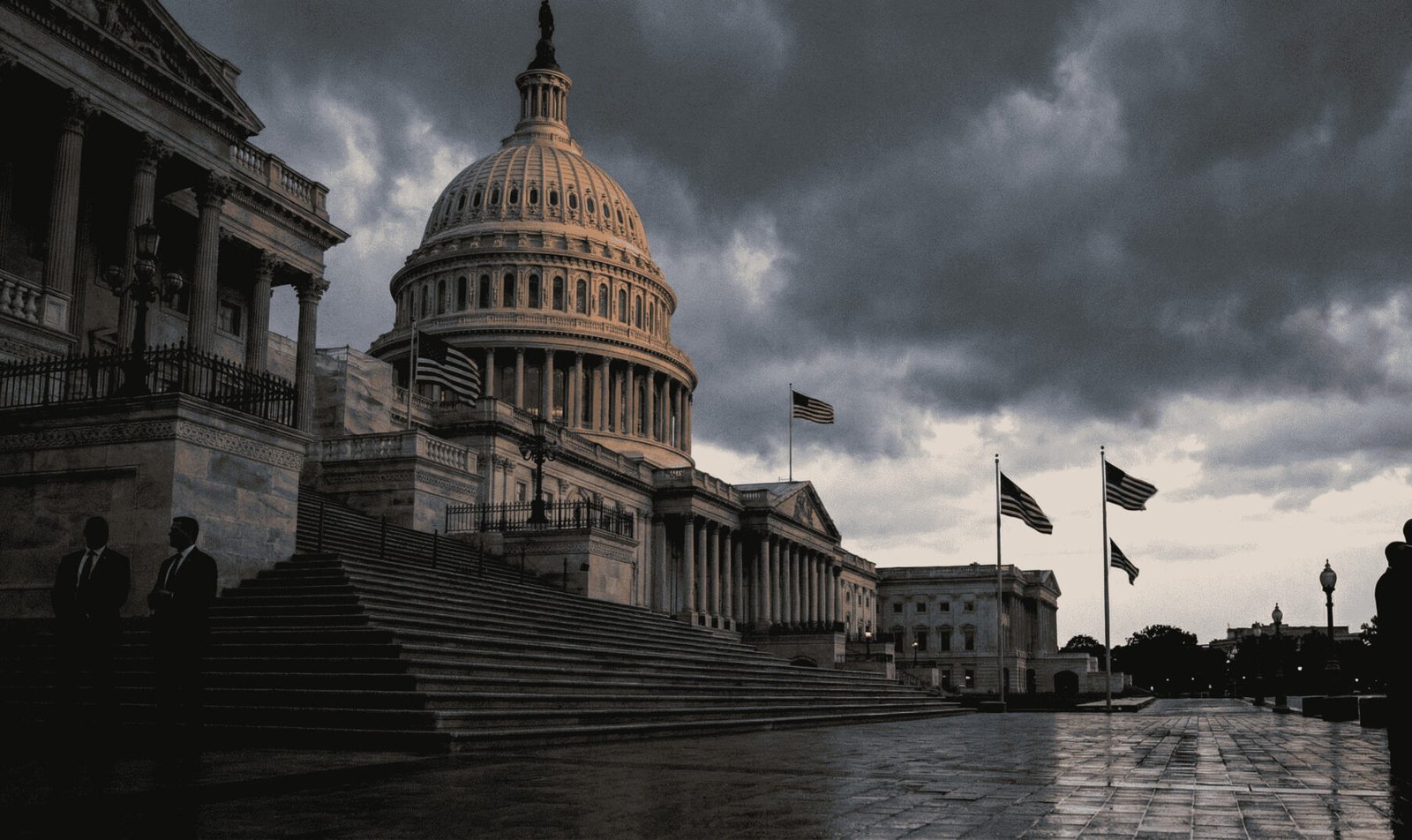
Washington, D.C. — The partial shutdown of the United States federal government appears poised to stretch longer than initially expected after House Democrats announced they will not fast-track a Senate-passed funding measure, escalating tensions in an already fragile political standoff. What began as a procedural delay has now evolved into a high-stakes confrontation over power, process, and priorities, leaving millions of Americans watching anxiously as essential government functions hang in the balance.
The refusal by House Democratic leaders to accelerate passage of the Senate’s stopgap funding bill has introduced fresh uncertainty into negotiations that many hoped would quickly reopen shuttered agencies. Instead, the decision has underscored how deeply divided Congress remains, not just over spending levels but over the very rules by which legislation should advance during moments of national disruption.
As the shutdown continues, the consequences are becoming more tangible, from unpaid federal workers to delayed services, while political blame shifts rapidly between parties attempting to control the narrative.
Table of Contents
Why Democrats Are Saying No to Fast-Tracking
House Democratic leadership has been clear in its stance: while they support funding the government, they will not waive normal legislative procedures to speed through a Senate deal they believe was crafted without sufficient bipartisan input from the House. According to Democratic lawmakers, fast-tracking the bill would reward what they describe as rushed negotiations and sideline meaningful debate on critical issues, particularly immigration enforcement and homeland security oversight.
Democratic leaders argue that the Senate package, although passed with bipartisan votes, reflects compromises made under pressure rather than consensus built through transparent deliberation. They maintain that the House has a constitutional role equal to the Senate and should not be expected to rubber-stamp legislation simply to meet an artificial deadline.
This position has frustrated Republican leaders, who contend that extraordinary circumstances demand extraordinary measures and that prolonging the shutdown harms Americans more than it helps legislative integrity.
The Senate Bill at the Center of the Storm
The Senate-passed funding measure was designed as a temporary solution, extending funding for most federal agencies while allowing additional time to negotiate unresolved disputes related to the Department of Homeland Security. Senate leaders from both parties framed the bill as a pragmatic compromise, arguing it would prevent disruption while preserving space for continued talks on immigration policy.
However, House Democrats say the bill places too much faith in future negotiations that may never materialize. They worry that once the government reopens, momentum for addressing controversial but important reforms could evaporate, leaving underlying problems unresolved until the next funding crisis.
For Democrats, the refusal to fast-track is not opposition to funding itself but resistance to what they see as a pattern of governing by deadline and emergency.
Republican Frustration and Internal Pressure
Republicans, particularly House leadership, have responded with visible irritation. They argue that Democrats are exploiting procedural leverage to extract concessions unrelated to immediate funding needs. Speaker allies insist that every additional day of shutdown deepens public frustration and undermines confidence in government institutions.
At the same time, Republican leaders face pressure from within their own ranks. Conservative members are wary of any bill that does not include stronger border security provisions, while moderates fear voter backlash if the shutdown drags on too long. This internal tension has made it harder for House Republicans to present a unified front, even as they accuse Democrats of obstruction.
The result is a complex political chessboard where neither side wants to blink first.
Shutdown Impacts Begin to Spread
Although the current shutdown is partial rather than total, its effects are becoming increasingly visible. Thousands of federal employees have been furloughed, while many others continue working without pay. Agencies affected by the funding lapse have scaled back operations, delaying everything from regulatory reviews to grant processing.
Air travel, often a flashpoint during shutdowns, remains operational for now, but transportation officials warn that prolonged uncertainty could strain staffing levels. National parks and museums face limited services, and some research programs have paused mid-project.
For families dependent on timely government services, the shutdown is more than a political headline. It is a disruption felt in daily routines, financial planning, and long-term stability.
Public Opinion and Political Risk
Polling conducted during previous shutdowns suggests that voters tend to punish both parties when government closures persist, though perceptions of blame can shift depending on messaging and media coverage. With elections on the horizon, lawmakers are acutely aware that prolonged dysfunction could carry electoral consequences.
Democrats appear to be betting that standing firm on process and principles will resonate with voters tired of crisis-driven governance. Republicans, meanwhile, are emphasizing urgency and economic harm, hoping to frame Democratic resistance as reckless delay.
The battle is not only legislative but rhetorical, playing out across press conferences, social media, and cable news.
Historical Echoes of Past Shutdowns
The current standoff evokes memories of past shutdowns, particularly those in the late 2010s, when funding disputes over immigration led to weeks-long government closures. Those episodes revealed how shutdowns can reshape political alliances, harden partisan identities, and erode trust in federal institutions.
History also shows that shutdowns rarely resolve the deeper issues that cause them. Instead, they often postpone hard decisions while inflicting collateral damage on workers and communities. Critics argue that the present confrontation risks repeating that cycle, with process battles overshadowing policy solutions.
Supporters counter that refusing to rush legislation is the only way to break the pattern.
White House Caught in the Middle
The White House has urged swift action to reopen the government, emphasizing the economic and human costs of delay. Administration officials have called on both chambers of Congress to find common ground, while stopping short of directly criticizing House Democrats’ procedural stance.
Privately, aides acknowledge that the shutdown complicates policy priorities, from disaster response coordination to international diplomacy. Each additional day without full funding consumes political capital and distracts from broader agendas.
The administration’s challenge is to encourage compromise without appearing to side too strongly with either faction in Congress.
What Happens Next in Congress
With House Democrats refusing to fast-track the Senate bill, lawmakers face several possible paths forward. One option is renegotiation, with Senate leaders revisiting the package to address House concerns. Another is political escalation, with each side attempting to force concessions through public pressure.
There is also the possibility of a short-term procedural agreement that allows debate while minimizing delay, though such solutions require trust that is currently in short supply.
Until a breakthrough occurs, the shutdown will remain in place, with agencies operating under contingency plans and workers left in limbo.
Federal Workers Bear the Cost
Behind the political maneuvering are hundreds of thousands of federal employees whose lives are directly affected by the impasse. Many are facing uncertainty about paychecks, childcare, and household budgets. While Congress debates process, these workers are forced to absorb the practical consequences of dysfunction.
Unions representing federal employees have criticized lawmakers across the aisle, arguing that shutdowns treat public servants as bargaining chips rather than professionals delivering essential services.
Their frustration adds moral weight to calls for a faster resolution.
Economic Ripples Beyond Washington
Economists warn that even short shutdowns can have measurable economic impacts, particularly if consumer confidence dips or small businesses dependent on federal contracts face payment delays. The longer the shutdown continues, the greater the risk of compounding effects.
Local economies in regions with high concentrations of federal workers are especially vulnerable. Restaurants, childcare providers, and service industries often feel the slowdown first.
These ripple effects add urgency to negotiations, even as political calculations slow progress.
A Test of Congressional Governance
At its core, the refusal to fast-track the Senate funding bill represents a broader debate about how Congress should function in moments of crisis. Should speed override scrutiny, or should procedure remain sacrosanct even at the cost of disruption?
House Democrats have answered that question clearly, choosing deliberation over haste. Whether that choice leads to better policy or deeper paralysis remains to be seen.
What is certain is that the decision has transformed a funding lapse into a defining test of legislative norms.
Conclusion: Uncertainty with No Immediate End
As negotiations grow more contentious, the path out of the shutdown looks increasingly uncertain. House Democrats’ refusal to fast-track the Senate measure has slowed momentum and raised the stakes, forcing both parties to confront the consequences of inflexibility.
For Americans watching from outside Washington, the details of parliamentary procedure may seem remote, but the effects are anything but. Each day of shutdown reinforces a sense of instability and frustration with political leadership.
Until Congress bridges its procedural and policy divides, the government remains partially closed, the nation waits, and the cost of delay continues to rise.