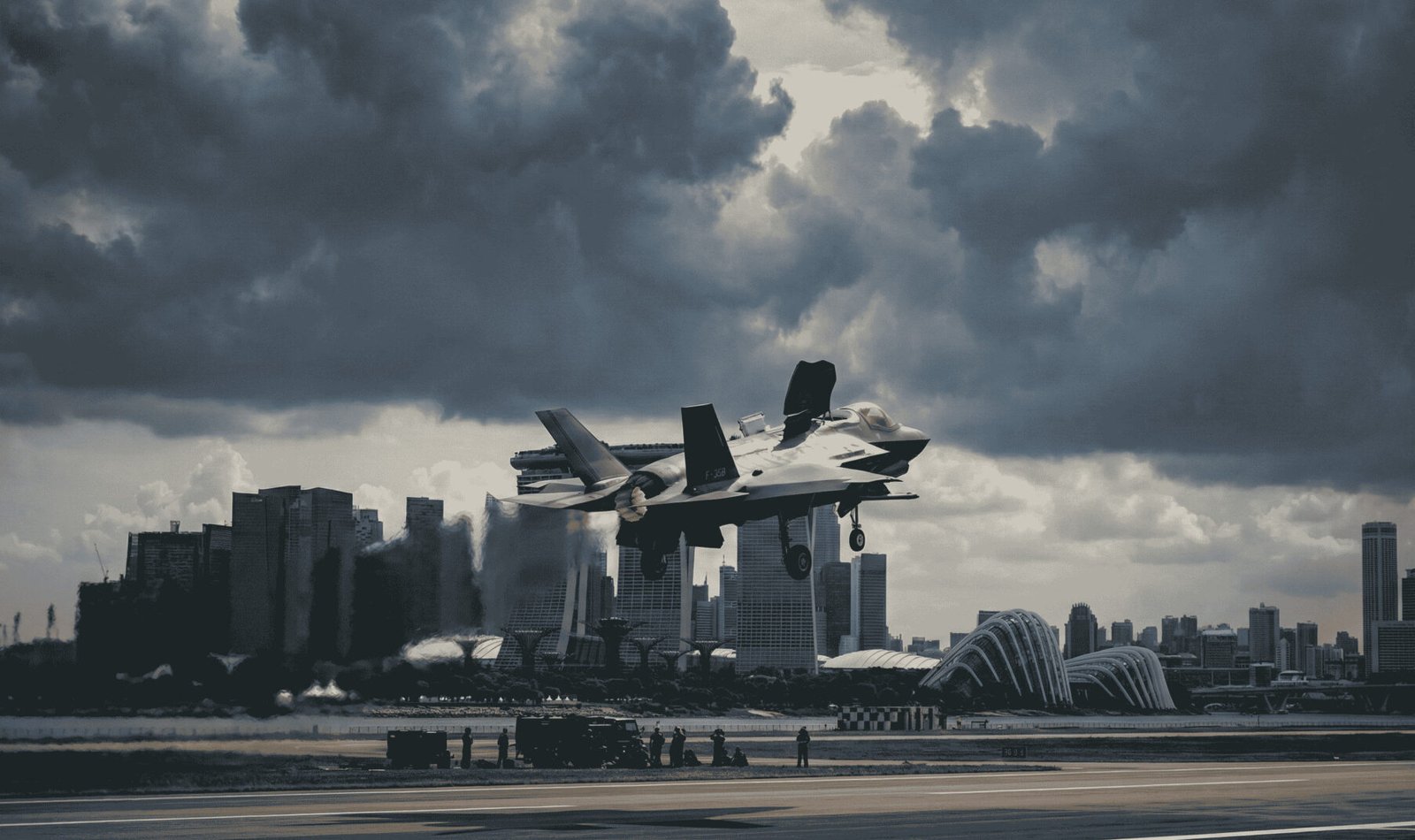
In the modern world of military aviation, size often seems to matter. Large countries with vast territories, massive populations, and enormous defence budgets usually dominate conversations about air power. Yet Singapore, a tiny island nation with just six million people and an area of roughly 280 square miles, is quietly proving that strategic thinking and technological investment can outweigh geography. The city-state is set to become the first country outside the United States to operate the advanced F-35B short take-off and vertical landing fighter jets from land bases, marking a historic moment in global military aviation.
Singapore’s decision to acquire the F-35B is not simply about adding a new aircraft to its fleet. It represents a carefully calculated move shaped by geography, regional security concerns, and a long-standing national philosophy that prioritizes deterrence and preparedness. With limited land, dense urban development, and no strategic depth, Singapore cannot afford traditional defence thinking. Instead, it relies on speed, precision, and advanced technology to protect its sovereignty and economic lifelines.
Table of Contents
Why the F-35B Matters More for Singapore Than Most Countries
The F-35B is a unique variant of the fifth-generation Lightning II family. Unlike conventional fighter jets, it can take off from very short runways and land vertically, thanks to its powerful lift fan and advanced propulsion system. For Singapore, this capability is transformative. The country has only a handful of air bases, all of which are well known and potentially vulnerable during a conflict. The ability to disperse aircraft across multiple locations dramatically improves survivability.
With F-35B jets, Singapore can operate from shorter runways, reinforced roads, or specially prepared landing pads. This reduces reliance on large, fixed airfields that could be targeted by enemy missiles. In wartime, flexibility equals survival, and the STOVL capability provides exactly that. It allows Singapore’s air force to keep fighting even if its primary bases are damaged or temporarily disabled.
Beyond basing flexibility, the F-35B offers stealth, advanced sensors, and unmatched data-sharing capabilities. The aircraft acts as a flying sensor hub, collecting and distributing battlefield information in real time. This situational awareness gives Singapore a decisive edge, allowing it to detect threats earlier and respond faster than potential adversaries.
The Journey to Acquiring the F-35B Fighter Jet
Singapore’s interest in the F-35 dates back more than a decade. The Republic of Singapore Air Force began evaluating options to replace its ageing F-16 fleet, knowing that future conflicts would demand stealth and network-centric warfare capabilities. After extensive analysis and trials, Singapore selected the F-35B variant, recognizing that its STOVL capability best suited the nation’s unique constraints.
In 2019, Singapore signed a deal worth approximately 2.75 billion dollars to acquire four F-35B jets from the United States. This initial purchase was intended to evaluate the aircraft in local conditions and develop operational expertise. The results were convincing. In 2023, Singapore exercised its option to buy eight additional F-35B jets, bringing the total to twelve. Later, the country also announced plans to acquire eight F-35A variants, creating a mixed fleet of twenty fifth-generation fighters.
The first four F-35B aircraft are expected to be delivered by the end of 2026. Once operational, Singapore will officially become the first nation outside the United States to deploy F-35B jets from land bases, a distinction that underscores its forward-looking defence strategy.
A Disproportionately Strong Air Force for a Tiny Country
Despite its small size, Singapore operates one of the most advanced air forces in Southeast Asia. The Republic of Singapore Air Force is built around quality rather than quantity, focusing on high-end platforms and extensive training. Its current fleet includes modernized F-16C and F-16D fighters, F-15SG Strike Eagles, Apache attack helicopters, maritime patrol aircraft, and airborne early warning systems.
Singapore also places great emphasis on pilot training and joint exercises. Due to limited airspace at home, many RSAF units train overseas in countries such as the United States and Australia. This exposure to diverse environments and large-scale exercises ensures that Singaporean pilots maintain world-class proficiency.
The introduction of the F-35B will elevate the RSAF even further. The stealth fighter will integrate seamlessly with existing platforms, enhancing the effectiveness of the entire force. Rather than replacing older aircraft overnight, the F-35B will act as a force multiplier, guiding other jets and assets with superior battlefield awareness.
Regional Security and Strategic Significance
Singapore’s defence decisions cannot be separated from its regional environment. Southeast Asia is becoming increasingly complex, with rising military budgets, territorial disputes, and growing great-power competition. While Singapore is not directly involved in the South China Sea disputes, it depends heavily on free and secure sea lanes for trade and energy supplies.
By investing in advanced air power, Singapore strengthens its deterrence posture. The presence of F-35B jets sends a clear signal that any aggression would be costly and uncertain. Deterrence, for Singapore, is not about projecting power abroad but about preventing conflict at home.
At the same time, Singapore maintains strong defence relationships with multiple partners, including the United States. Operating the F-35 enhances interoperability with allied forces, allowing Singapore to participate effectively in joint operations if needed. This balance of neutrality, capability, and partnership has long been a cornerstone of Singapore’s security policy.
More Than Military Power: The Singapore Model
Singapore’s ability to field such advanced military capabilities is rooted in its broader national success. Despite lacking natural resources, the country has built a globally competitive economy through smart governance, investment in education, and world-class infrastructure. Its port is among the busiest in the world, and its airport is consistently ranked as one of the best.
This economic strength supports sustained defence spending, allowing Singapore to invest in cutting-edge technology without compromising social development. Defence is viewed not as a burden but as an essential pillar of national survival.
Singapore’s global influence also extends beyond economics and security. Its strong passport, diplomatic credibility, and reputation for stability give it soft power that far exceeds its physical size. The acquisition of the F-35B fits into this broader narrative of a small nation that consistently operates at a global level.
Conclusion: Redefining What Military Strength Looks Like
Singapore’s move to operate F-35B STOVL fighter jets is a powerful reminder that military strength is no longer defined by land area or population size. Instead, it is shaped by strategy, technology, and long-term planning. By choosing an aircraft perfectly suited to its geographic realities, Singapore has turned its limitations into advantages.
As the first F-35B jets arrive and become operational, Singapore will set a precedent for other small, strategically important nations. It demonstrates that with the right choices, even the smallest country can command respect in an increasingly uncertain world. In doing so, Singapore is not just upgrading its air force. It is rewriting the rules of modern defence.