For over a century, Albert Einstein’s theory of general relativity has been science’s most powerful guide to gravity—from curving space around stars to predicting the existence of black holes. But despite its enduring success, scientists have long wondered: Could there be cracks in this historic theory? A dramatic new detection from the depths of space, involving the clearest gravitational wave ever observed, is now giving researchers a stunning chance to put Einstein to one of his toughest tests yet.
Table of Contents
This moment isn’t just a technical milestone—it’s a crossroads in our understanding of gravity, spacetime, and perhaps the entire universe itself.
A Cosmic Bell Toll: The Story Behind GW250114
In January 2025, gravitational wave detectors around the world recorded a cosmic event that sounded like a bell across spacetime. Known as GW250114, this signal came from the collision and merger of two massive black holes—objects so dense that not even light escapes their grip.
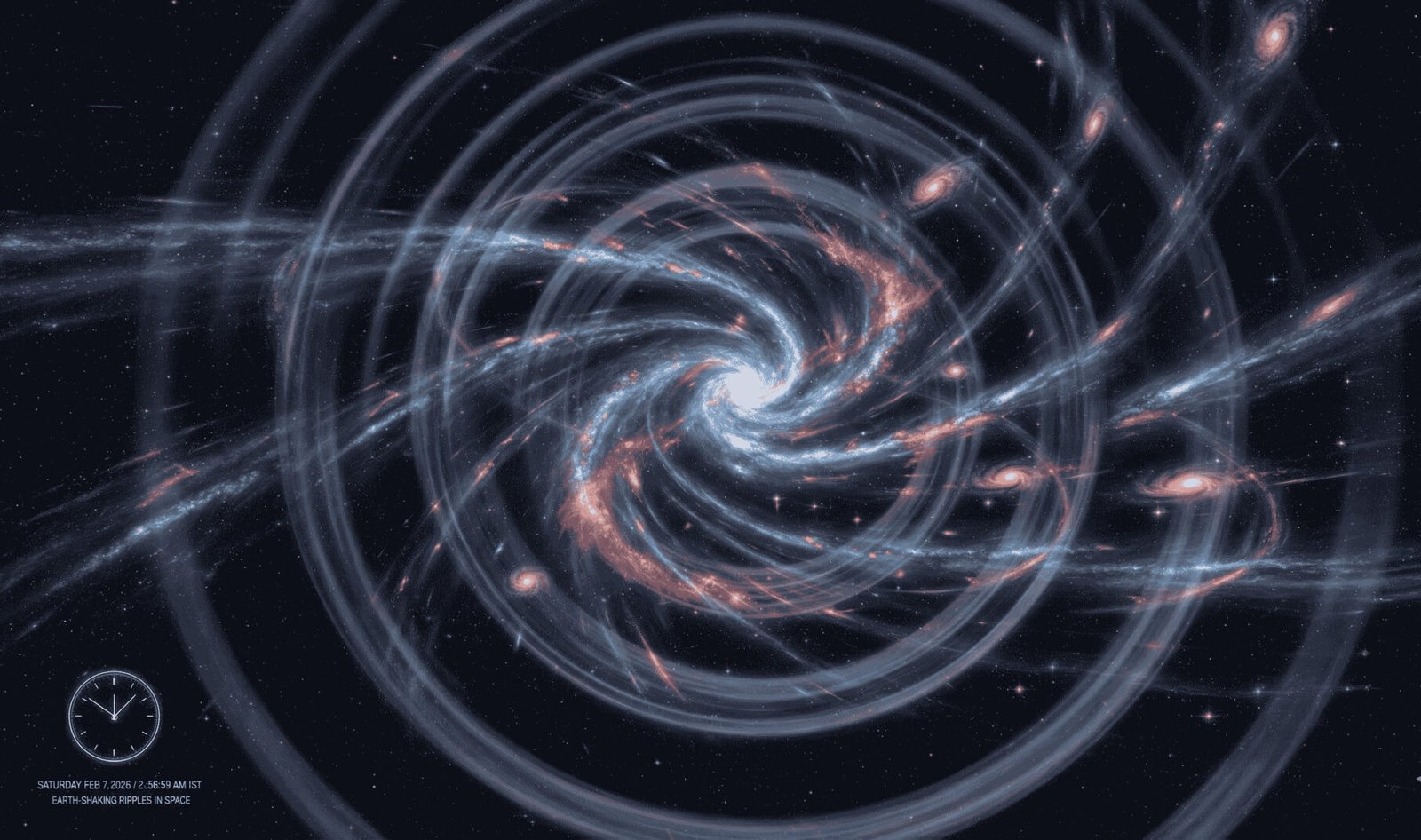
Gravitational waves are ripples in the fabric of space itself, first predicted by Einstein in 1916. They propagate outward from cataclysmic events like black hole mergers, carrying information about the violent processes that created them. But GW250114 was different: it was exceptionally clear. Scientists could, for the first time, precisely measure multiple “tones” emanating from the ringing spacetime, much like distinct notes from a struck bell.
Why is this remarkable? Because each tone contains clues about the physical properties of the newly formed black hole—its mass, spin, and even how space is curved around it. And when these multiple tones align with Einstein’s predictions, they provide one of the most exacting confirmations of general relativity ever achieved.
Einstein’s Theory Under the Microscope
General relativity has passed many tests: bending starlight during eclipses, predicting the orbit of Mercury, and most recently, the existence of gravitational waves themselves. But all theories have limits, and physicists have long suspected that Einstein’s model isn’t the final word on gravity.
Here’s why.
Einstein’s equations don’t incorporate quantum mechanics—the physics that governs the smallest scales of matter. They also struggle to explain mysterious phenomena like dark matter and dark energy, which together make up about 95% of the universe but remain invisible and poorly understood.
Because of these gaps, scientists look for places where general relativity might fail—especially in the most extreme corners of the cosmos. Black holes and their gravitational waves are among the best laboratories for this purpose.
Listening to the Universe: What GW250114 Revealed
When two black holes merge, they don’t immediately become silent—after the collision, the new black hole rings. These vibrations aren’t sound waves, of course, but gravitational waves with specific frequencies and damping times (how quickly they fade). By measuring these tones, scientists can reverse-engineer the properties of the black hole.
Here’s the key: general relativity makes very specific predictions about how these tones relate to each other based on the mass and spin of the final black hole. If the measurements from GW250114 agree with these predictions, it’s a powerful confirmation of Einstein’s theory. And that’s precisely what scientists found.
Thanks to improvements in global gravitational wave observatories like LIGO in the U.S., Virgo in Europe, and KAGRA in Japan, researchers could extract multiple tones from GW250114 with unprecedented clarity, and all of them aligned beautifully with general relativity’s predictions.
That means, at least for this event, Einstein was right again.
But the Story Isn’t Over
Detecting agreement with Einstein’s theory is impressive—but scientists are just as excited about the possibility of disagreement.
Why? Because even though general relativity works extraordinarily well, researchers expect it to eventually fall short—especially when gravity interacts with quantum physics.
Physicist Keefe Mitman, a co-author of the new research published in Physical Review Letters, explained that future gravitational waves might show slight differences from what Einstein predicted. If those deviations are observed, they could point us toward a new theory of quantum gravity—one that unifies general relativity with the laws governing subatomic particles.
Imagine that: the keys to a deeper understanding of the universe hidden in the faint echoes of space itself.
Why This Matters: New Horizons in Physics
GW250114’s confirmation of general relativity is historic. But its greatest contribution may be the doorway it opens to new physics.
Here’s what’s at stake:
Testing the Limits: Every clear gravitational wave signal pushes general relativity into a new realm of precision testing. Future deviations could expose cracks in the theory and point toward physics beyond Einstein.
Quantum Gravity: A major goal of modern physics is reconciling relativity with quantum mechanics. Gravitational waves may provide the first experimental evidence needed to guide this unification.
Dark Matter and Dark Energy: While gravitational waves don’t directly detect dark matter or dark energy, they could help scientists learn how gravity behaves in environments shaped by these mysterious components of the universe.
Space as a Laboratory: Unlike particle accelerators on Earth, gravitational waves allow scientists to probe physics at energy scales and distances that are otherwise unreachable.
What Comes Next? The Future of Gravitational Wave Astronomy
Now that detectors can capture such clear signals, researchers are preparing for a new era of discoveries.
Improvements in sensitivity and coverage—especially with next-generation ground-based instruments and future space-based observatories—will allow scientists to observe a wider variety of cosmic events. That includes mergers involving neutron stars and even the slow dances of extreme mass-ratio inspirals—systems where a small object orbits a supermassive black hole.
With more diverse data, physicists hope to answer some of the deepest questions in science:
Are there hidden signatures of quantum gravity?
Can gravitational waves reveal dark matter structures near black holes?
Will future signals ever deviate from general relativity’s predictions?
Each new detection brings us closer to understanding not just how gravity works, but why it works the way it does.
Conclusion: Einstein Was Right—But Not the Final Word
The gravitational wave GW250114 stands as one of the most remarkable confirmations of Einstein’s general relativity ever observed. Its clarity and consistency with Einstein’s predictions are breathtaking, reaffirming the power of a theory that has stood for over a century.
At the same time, the implications of these findings stretch far beyond a single success. They mark the beginning of a deeper, more detailed investigation into gravity’s true nature—a quest that could eventually lead to a new chapter in physics, where general relativity and quantum mechanics are united in a single coherent framework.
In the end, Einstein may remain a giant on whose shoulders we stand—but the universe has many more secrets to share, and gravitational waves may be the key to unlocking them.