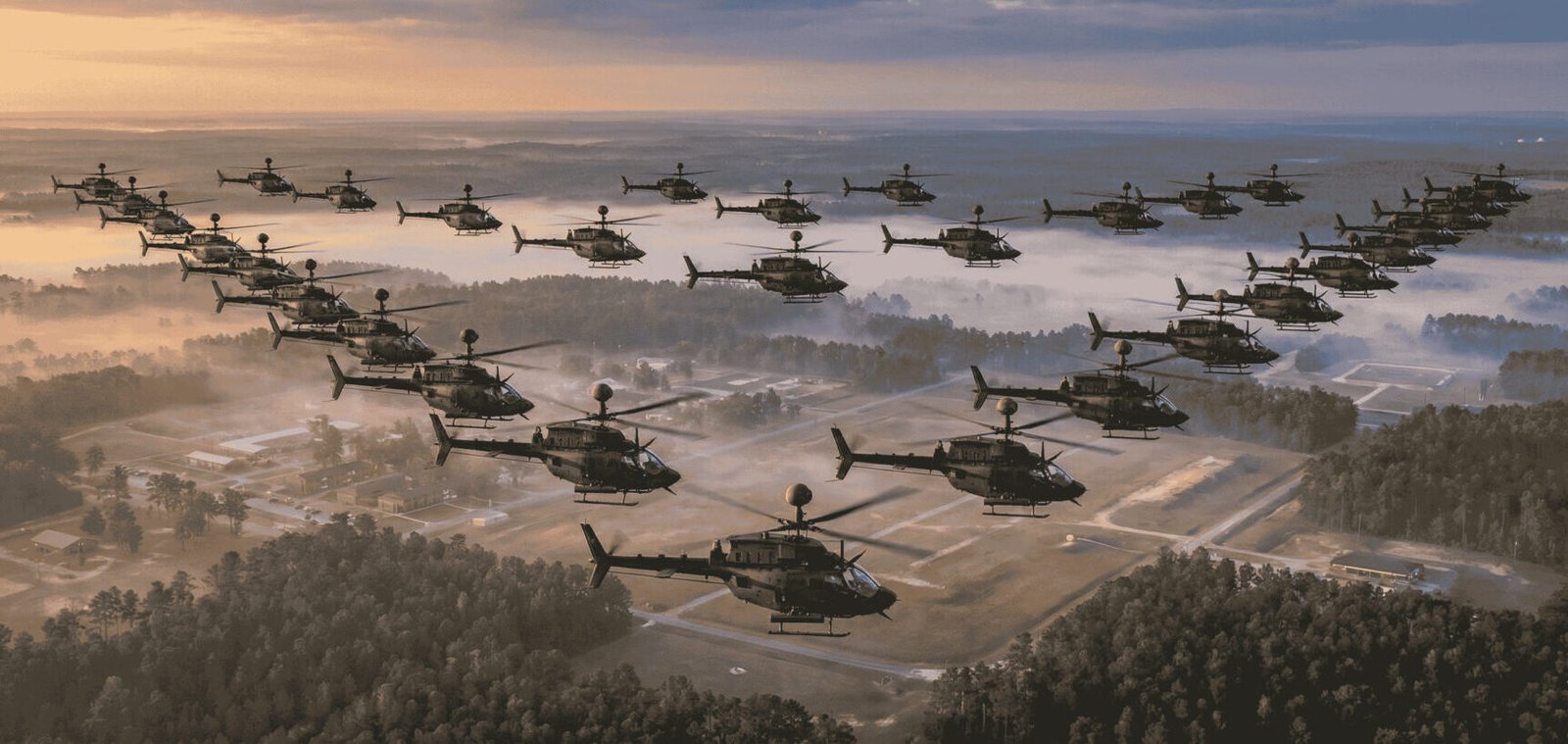
On April 15, 2016, the skies above Fort Bragg, North Carolina witnessed an extraordinary event that would go down in aviation history. In what began as a symbolic farewell flight for a retiring helicopter fleet, 32 U.S. Army helicopters rose into the air in a flawless, synchronized formation—setting a Guinness World Record for the largest helicopter formation flight ever recorded.
Nearly a decade later, that airborne achievement continues to inspire awe among military pilots, aviation enthusiasts, and defence strategists around the world—not just for the sheer scale of the formation but for the precision, skill, and planning it required. Here’s an in-depth look at this remarkable feat, why it matters, and its enduring significance for military aviation.
Table of Contents
From Farewell to History: How the Mission Took Shape
The mission was not originally planned as a record attempt. It was conceived as a tribute: a final showcase for the Bell OH-58D Kiowa Warrior, a light observation and reconnaissance helicopter that had served the U.S. Army for decades.
On that spring morning, 32 Kiowa Warriors—each meticulously maintained and flown by seasoned Army aviators—taxied to their take-off positions at Simmons Army Airfield. What followed was not just a ceremonial flight, but a testament to discipline, teamwork, and aerial mastery.
A Perfect Symphony of Rotor and Thrust
Formation flying is never easy. It demands exact spacing, constant communication, and split-second adjustments. But flying 32 helicopters as a cohesive unit—maintaining consistent speed, altitude, and alignment across a broad airspace shared with civilian aircraft—was a challenge at an entirely different level.
Pilots had to compensate for unpredictable turbulence, rotor wash from neighboring aircraft, and changing wind conditions—all while preserving their positions within inches of perfection. This level of coordination required not only pilot expertise but intensive planning and rehearsal.
What Made the Kiowa Warrior So Special
Versatility and Combat Proven
The Bell OH-58 Kiowa Warrior wasn’t just another helicopter—it was a workhorse of modern warfare. Light, agile, and versatile, it was designed for:
- Armed reconnaissance missions
- Target acquisition and laser designation
- Close coordination with ground troops
Its lightweight design and excellent visibility allowed pilots to operate close to terrain, making it invaluable in combat zones where stealth and maneuverability were essential.
A Farewell Flight with a Legacy
By 2016, the Kiowa Warrior was being phased out under the U.S. Army’s aviation restructuring initiative, replaced by heavier attack helicopters and unmanned aerial systems (UAS). Though the newer systems brought advanced technology, they lacked the Kiowa’s unique balance of agility and reliability.
This final formation flight was more than a farewell—it was a demonstration of everything the platform had meant to Army aviation.
Behind the Scenes: What It Took to Break the Record
Coordinating 32 helicopters wasn’t something that happened overnight.
Strategic Preparation
Teams conducted extensive pre-flight simulations, airspace coordination with civilian authorities, and ground logistics planning that involved hundreds of personnel. Every detail—from fuel scheduling to radio protocols—had to be synchronized.
Pilot Precision and Training
Each aviator involved had to be intimately familiar not only with their own helicopter’s performance envelope but also with the dynamics of formation flying. Constant communication and sharp situational awareness were essential to avoid collisions and maintain formation integrity.
Multi-Agency Coordination
Because the flight spanned civilian airspace near Fayetteville, North Carolina, coordination with the Federal Aviation Administration (FAA) was crucial. Controllers worked in real time with military pilots to ensure safety and compliance with air traffic regulations—all while allowing the record attempt to proceed.
The Guinness Recognition
Following the flight, official validation came from Guinness World Records, which confirmed that 32 helicopters flying in formation was unprecedented and unmatched. This wasn’t just a military accolade—it was an achievement recognized on the global stage.
Today, it stands as the world’s largest helicopter formation flight—a record that continues to be cited in aviation histories and military training curricula around the world.
Why This Record Still Matters Today
Nearly ten years on, this historic formation flight remains relevant not merely because of its scale, but due to what it reveals about:
1. Aerial Coordination and Skill
Military aviation isn’t just about advanced technology. It’s about human skill, mutual trust, and coordination under pressure—qualities that this flight showcased in dramatic fashion.
2. Strategic Air Mobility
Large formation flights demonstrate the ability of an air force to mass assets quickly and safely—a capability with real wartime and humanitarian implications.
3. Lessons in Platform Modernization
The retirement of the Kiowa Warrior without an immediate successor exposed a capability gap for light reconnaissance helicopters. While Apache attack helicopters and drones were expected to take over reconnaissance roles, neither has fully matched the Kiowa’s agility and flexibility.
This has led defence planners worldwide to rethink the value of manned light aviation platforms, especially as nations modernize their rotary fleets. From South Korea to Poland and Australia, several countries have invested in new light scout helicopter programs, recognizing the unique tactical advantages they offer.
The Future of Helicopter Formations
With advances in autonomous flight systems, sensors, and battlefield networking, future helicopter formations may look very different. Concepts being explored today include:
Autonomous Wingmen
Unmanned rotorcraft operating alongside manned helicopters could multiply operational effectiveness, potentially flying in formation while performing complex surveillance and support tasks.
Next-Gen Helicopter Platforms
Programs like the U.S. Army’s Future Long-Range Assault Aircraft (FLRAA) and Future Attack Reconnaissance Aircraft (FARA) are aimed at bringing new capabilities to the battlefield by the early 2030s. These efforts seek to combine speed, range, and agility in ways that legacy platforms could never achieve.
While these technologies hold promise, they also raise questions about training, safety, and doctrine—questions that historic achievements like the 2016 formation flight help to illuminate.
Reflections From the Pilots and Ground Crew
Veterans of the 32-helicopter mission often describe it not as a record to be broken, but as a shared moment of pride. For many, it was less about setting a world record and more about celebrating decades of service, teamwork, and the sheer joy of flying.
A pilot who took part in the flight once remarked that formation flying was like “conducting a symphony in the sky”—every rotor blade, every engine note, perfectly synchronized, yet invisible to the casual eye.
Legacy in Military Doctrine and Training
Today, Army aviation schools refer to this flight when teaching leadership, airspace management, and mass mobilization techniques. It’s used as an example of how detailed planning and disciplined execution can lead to historic achievements—even when the odds are daunting.
Some military analysts also view it as a cautionary lesson: the retirement of an effective platform without a fully capable replacement can lead to gaps that are hard to fill in fast-moving operational environments.
A Record That Inspires Generations
The April 2016 helicopter formation stands not only as a world record but also as a cultural touchstone in aviation. It reminds us that:
- Human skill remains irreplaceable, even in an age of automation
- Teamwork and preparation matter as much as machinery
- Records reflect legacy as much as performance
For young pilots and engineers entering the field, this event continues to serve as inspiration—proof that monumental achievements often start with a shared vision and relentless effort.
Conclusion: When Precision Meets Passion
The U.S. Army’s record-setting helicopter formation was not just a flight—it was a narrative of human dedication, technical brilliance, and strategic foresight. It transcended its original ceremonial purpose to become a defining moment in aviation history.
As helicopters continue to evolve and new technologies take flight, that formation over Fort Bragg will remain a landmark achievement—a reminder that even in an era of drones and digital warfare, real wings are still capable of making history.