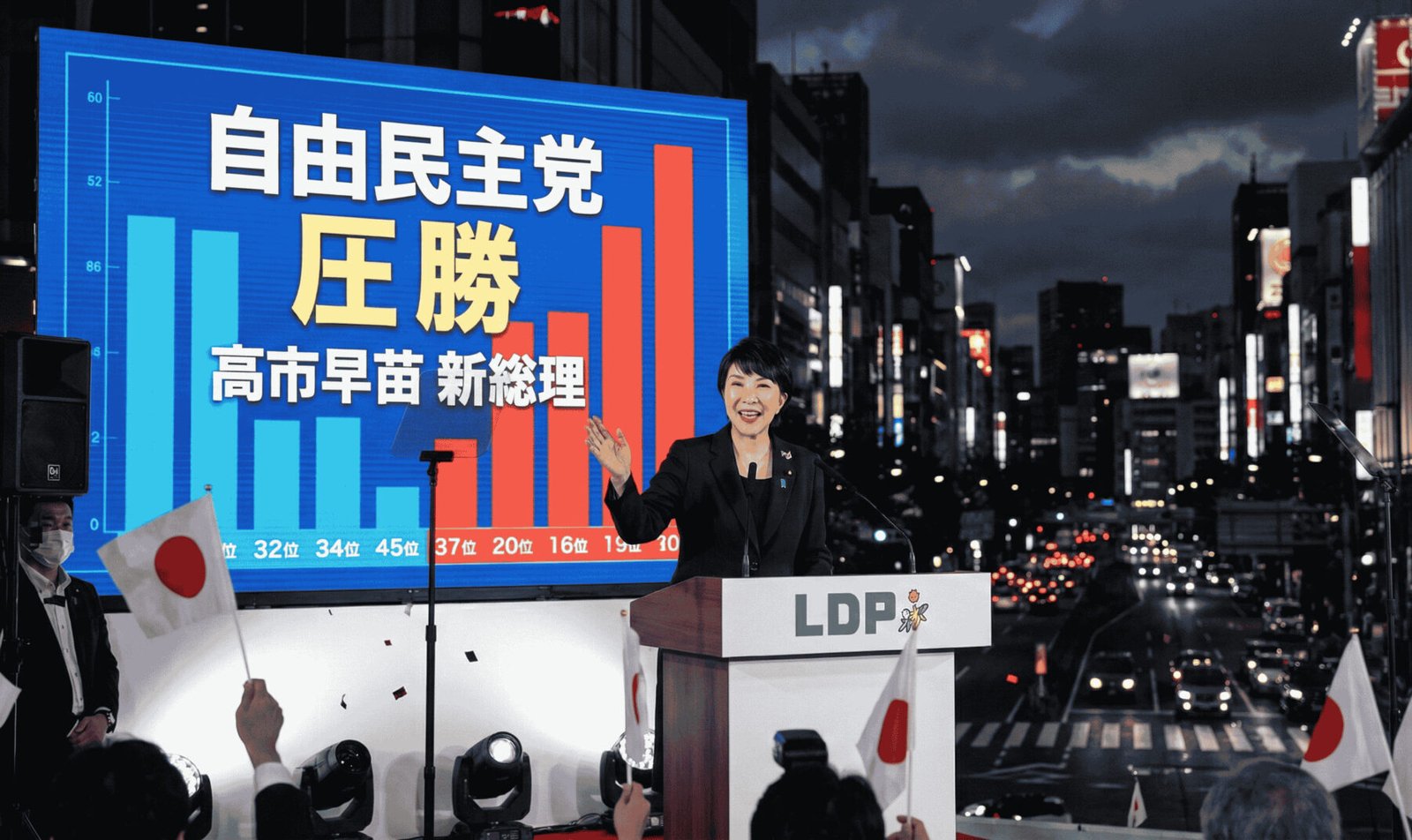
In a political moment that has riveted the world, Japan’s Prime Minister Sanae Takaichi has led her party to a stunning landslide victory in the country’s snap general election, securing an overwhelming mandate from voters and reshaping the nation’s political landscape.
This sweeping triumph not only cements her leadership at home but also has significant implications for Japan’s role in global affairs, economic direction, and national identity.
Table of Contents
A stunning Turn in Japanese Politics
On Sunday, February 8, 2026, results from Japan’s snap election poured in, revealing a dramatic outcome: the ruling Liberal Democratic Party (LDP) under Sanae Takaichi secured a supermajority — winning more than two-thirds of the seats in the 465-member Lower House. According to official vote counts, the LDP alone clinched 316 seats, comfortably surpassing the threshold needed for absolute control.
What makes this result remarkable isn’t just the numbers — it’s how quickly and decisively the political tide turned. Takaichi called this snap election just three months after assuming office, betting that the nation’s mood was ripe for change. Voters responded with overwhelming confidence in her leadership.
From First Female PM to Political Powerhouse
Sanae Takaichi, 64, has long been a formidable figure within Japan’s political sphere. Known for her straightforward speaking style and determined approach, she made history as Japan’s first female prime minister, a milestone in a nation where political leadership has overwhelmingly been male. Her ascent to the premiership in late 2025 signaled a shift in Japan’s political norms, and this election win propels her into a rare sphere of broad popular support.
Her victory is not just symbolic — it’s transformational. Takaichi’s coalition performance far exceeds the mere majority traditionally needed to govern. Achieving a supermajority means her party can advance key legislative changes without depending on opposition support or approval from the Upper House — an unprecedented position in post-war Japanese politics.
Why Voters Chose Takaichi
The reasons behind this landslide run deep. Many Japanese voters have grown restless with slow economic growth, persistent inflation pressures, and ongoing concerns about national security. Takaichi tapped directly into these sentiments with a bold campaign focused on economic relief and a stronger Japan on the global stage.
One of her most compelling promises was to suspend the 8% sales tax on food for two years, a move aimed at easing the daily financial burden on households struggling with living costs. This pledge resonated particularly with younger voters and families, helping broaden her appeal.
Takaichi also offered a clear vision for economic stimulus and reforms — including proposals for corporate tax incentives that favor domestic reinvestment, increased government spending on technology and manufacturing sectors, and fiscal measures to boost growth after years of stagnation.
On security and defense, her message was equally decisive. Against the backdrop of rising regional tensions — particularly concerning China and the strategic importance of Taiwan — Takaichi presented a tougher stance on national defense. She advocated increased defense capabilities and a more assertive foreign policy that moves Japan beyond its post-World War II pacifist constraints.
Together, these economic and security themes created a narrative of proactive leadership that attracted broad public support at a time when many felt Japan needed clarity and confidence at the top.
A New Political Era for Japan
Takaichi’s supermajority doesn’t just give her party control of the Lower House — it offers new political leverage with historic potential. Because the LDP can override the Upper House even without its cooperation, legislation on major issues — from tax policy to constitutional revision — could move forward with unprecedented speed.
This is especially significant in areas like constitutional reform. For decades, efforts to revise Japan’s post-war pacifist constitution have faced strong political and public resistance. With a supermajority, Takaichi now has the political capital to reopen debates on national security clauses and Japan’s global defense posture — though any constitutional changes would still require broader public approval.
Domestically, this shift could smooth the path for tougher immigration policies and protective measures for domestic industries. International observers, meanwhile, are watching closely to see how this new Japan navigates its relationships with key global powers — particularly the United States and China.
Economic and Market Reactions
Japan’s financial markets reacted rapidly to the election results, underscoring how deeply politics and economics are intertwined. On Monday following Takaichi’s win, Japan’s stock market surged, with the Nikkei 225 posting gains of more than 5% and hitting record highs.
In contrast, government bonds experienced rising yields — reflecting investor expectations of greater fiscal activity — and the yen showed volatility in currency markets. Analysts suggested that the market enthusiasm reflects optimism about a clear policy direction and stable governance, even as debates continue over financing methods for new government spending.
Global Reaction: Friendship and Strategic Implications
The reverberations of Takaichi’s victory were felt far beyond Japan’s borders. World leaders swiftly offered congratulations, recognizing the importance of Japan’s political direction both regionally and globally.
In India, Prime Minister Narendra Modi congratulated Takaichi warmly, calling her victory a “landmark” and expressing confidence that the India-Japan Special Strategic and Global Partnership would flourish under her leadership. Modi’s message — shared publicly on social media — emphasized cooperation on peace, stability, and shared prosperity.
International commentary also highlighted external endorsements that preceded the election. In the United States, prominent figures publicly backed Takaichi’s leadership, underlining the international community’s interest in Japan’s political direction.
For allies and rivals alike, Japan’s strong new mandate could shape diplomatic engagement strategies for years. Countries concerned with regional security — particularly in East Asia — are likely to recalibrate aspects of their policies in light of Japan’s more assertive approach under Takaichi.
Voices from the Ground: What Voters Said
Across Tokyo and Japan’s countryside, the election results sparked reactions reflecting a nation eager for decisive leadership.
Akihito Iwatake, a 53-year-old office worker, told reporters he welcomed the LDP’s victory, noting that the party had grown too liberal in recent years and that Takaichi’s conservative agenda felt like a necessary course correction.
Young voters, widely credited with bolstering Takaichi’s support, saw her messaging — particularly on tax relief and national pride — as refreshingly candid in a political culture often viewed as cautious and incremental.
At the same time, some critics have cautioned that strong executive control could sideline dissenting voices and create policy pathways that may not reflect the full complexity of public opinion. But for now, Takaichi’s social media presence — and the “Sanakatsu” cultural buzz around her campaign — suggests a broad base of enthusiasm among segments of the electorate.
Looking Ahead: What Comes Next
With this decisive election victory, Sanae Takaichi’s government faces a demanding yet exhilarating path forward. In the immediate term, the Lower House will reconvene to pass critical budgetary measures that address economic pressures and implement campaign promises. Revamped fiscal policy aimed at stimulating growth and mitigating inflation will be a priority.
Longer term, constitutional debate and defense policy reform loom large. How these conversations unfold could redefine Japan’s identity on the world stage — both politically and militarily. The relationship with China will be a central axis of this discourse, especially as public sentiment on diplomatic ties varies across the country.
And throughout these challenges, Takaichi’s leadership style — often described as candid, energetic, and resilient — will be tested as she transitions from campaign trail charisma to the nuanced demands of governance.
Conclusion
Prime Minister Sanae Takaichi’s landslide victory in Japan’s snap election marks a defining moment for the nation — politically, economically, and socially. With a supermajority in the Lower House, she enters a phase of powerful governance backed by a clear public mandate. Her policies promise bold reforms, economic relief, and a more assertive national posture, all while reshaping Japan’s role on the global stage.
As the world watches closely, Japan’s next chapter is unfolding with renewed momentum — and much of it centers on the leadership of a historic, transformational prime minister.