
Let’s be honest: Kolkata goes absolutely bonkers for football, especially when the colors are blue and white. This city doesn’t just watch the game; it lives it. Maradona is a local deity, and the streets turn into a sea of Argentine flags during every major tournament. So, when news officially dropped about Lionel Messi’s GOAT India Tour 2025 kicking off right here, the city wasn’t just excited—it was ready for a religious experience. This was meant to be the glorious return of a legend, the crowning moment since that unforgettable 2011 friendly against Venezuela.
Instead? We got a masterclass in administrative mayhem, a blink-and-you-miss-it, 22-minute disaster that left thousands of loyal fans feeling completely and utterly fleeced.
This isn’t just a report; it’s an autopsy of an event that had the perfect ingredients for triumph and somehow cooked up a recipe for absolute disaster. It’s a cautionary tale of celebrity culture, greed, and a staggering failure to prioritize the paying public. The promise was the GOAT; the delivery was a grand, humiliating farce.
Table of Contents
The Fever Pitch — Waiting for the World’s Best
Kolkata’s deep, passionate, and historic love affair with Argentine football is the stuff of legend. It’s a connection that transcends mere sport; it’s cultural osmosis. You see massive Maradona murals next to images of local Bengali heroes, and the city’s heart truly beats Albiceleste. After the cathartic, spectacular World Cup win in 2022, the anticipation for Messi’s arrival—now as a World Champion—was bordering on hysteria. This wasn’t just a player visiting; this was a modern god making a pilgrimage.
Everyone—from the grandmothers who remember Maradona’s magic, to the young children who stream every Inter Miami and former Paris Saint-Germain match, to the college students decked out in jerseys—was desperate for a glimpse. They didn’t just want to see him play; they wanted to offer their reverence.
The City Dressed in Blue and White
The whole city was dressed up for the occasion. Massive cardboard cutouts of Messi, rivaling the height of two-story buildings, adorned major intersections. Flags hung from every single balcony and rooftop, creating a vibrant, buzzing canopy over the streets. The energy you could practically feel crackling in the air was magnetic. Local tea stalls debated his legacy, sweet shops prepared special desserts, and local media covered every rumored detail of his itinerary. This wasn’t just a visit; it was the second coming, a civic holiday in the name of football. And, let’s face it, people were willing to spend crazy, life-savings money for it. The devotion was absolute, and the stage was set for greatness.
The VIP Midnight Landing: A Sign of the Chaos to Come
Messi, along with his legendary buddies Luis Suárez and Rodrigo De Paul, landed at Netaji Subhash Chandra Bose International Airport at a ridiculously early hour—around 2:30 a.m. on a Saturday morning. But guess what? The airport was already jammed! Hundreds of supporters, ignoring sleep, logic, and comfort, were camped outside Gate 4, chanting the names of their heroes at the top of their lungs. The sheer scale of the midnight crowd was an early warning sign the organizers should have heeded.
The police had a complete nightmare trying to contain the sprinting, frantic crowds. The star trio was rushed through the VIP exit and straight to a luxury hotel, which immediately turned into Fort Knox, packed with fans who had probably spent a bomb just to breathe the same air as the GOAT. The chaos at the airport—a desperate surge of human emotion against a thin line of security—was a microcosm of the catastrophic management failure that would unfold just a few hours later.
The Salt Lake Stadium — Where It All Fell Apart
The main event, a ‘Public Appearance and Felicitation Ceremony,’ was scheduled for the hallowed turf of the Vivekananda Yuba Bharati Krirangan—the colossal Salt Lake Stadium, a venue that has seen countless historic football moments. The plan was deceptively simple: a grand public appearance, a little wave to the fans, a statue unveiling, maybe a few words of gratitude. Instead, we got the textbook definition of a large-scale, self-inflicted fiasco.
💸 The Ticket Price Headache: A Premium Promise
Let’s talk about the money—the true foundation of the fans’ fury. The tickets weren’t just expensive; they were exorbitant for a non-match, purely ceremonial event. We’re talking anywhere from a steep Rs 4,500 at the entry-level to prices that went all the way past Rs 10,000 for ‘Premium’ and ‘VIP’ categories.
For the average Kolkata football fan, known for their passion but often operating on a tight budget, this is a massive chunk of change. These were prices normally reserved for international musical acts or World Cup qualifiers. Yet, people willingly shelled out, believing that the premium price guaranteed them a close, clean, and respectable view of the GOAT. They travelled for hours, skipped work, and brought their children, sacrificing greatly, only to discover a harsh truth: the event was not actually for them; it was for the elite on the pitch.
The Infamous 22-Minute Shame
Messi’s convoy rolled into the stadium complex just before noon. He stepped onto the track, ready to wave and acknowledge the thousands of adoring, ticket-holding fans who were screaming themselves hoarse, their hopes soaring.
And what happened next remains an unforgivable stain on the city’s event management history. The crowd of organisers, local netas (politicians), sports officials, and private security—the very people meant to manage the event—did the unforgivable.
They swarmed him.
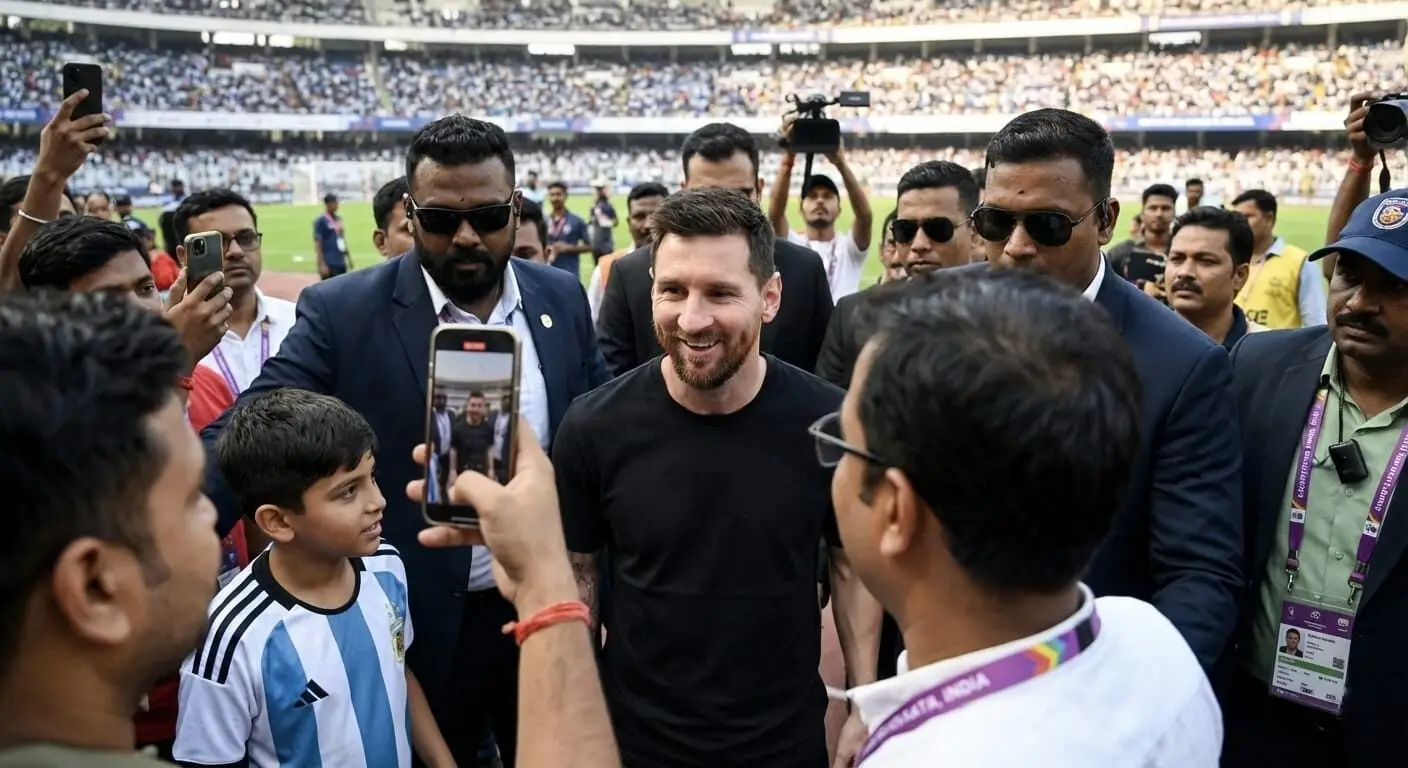
Seriously, 70 or 80 so-called VIPs formed a chaotic, impenetrable scrum around the Argentine star. They pushed and shoved each other with blatant self-interest, frantically vying for a selfie, completely blocking every single fan’s view. Imagine paying five or ten thousand rupees to spend 22 minutes watching the back of some local MLA’s head trying to take a blurry, self-serving photo. It was a spectacular display of ego over professionalism.
The stadium’s mood curdled instantly. The excited chants died, replaced by a furious, collective, and frustrated bellows directed squarely at the self-serving officials on the pitch. Messi, visibly uncomfortable and hemmed in, couldn’t even see the fans, let alone do a proper lap of honour or interact with the vast paying crowd.
In what felt like a brutal slap in the face to everyone who’d paid and waited, the star was essentially whisked away after just 22 minutes. The ‘grand event’ was over before the Chief Minister and even Shah Rukh Khan, a scheduled celebrity guest, could arrive. It was a humiliating collapse of basic crowd management, prioritizing the vanity of a few dozen people over the rights and experience of tens of thousands.
Mayhem and Missing Seats — The Fan Backlash
The reaction was immediate, explosive, and entirely justified. Fans felt betrayed, absolutely robbed of the experience they had sacrificed for. The atmosphere shifted from reverent excitement to volcanic anger in a matter of seconds.
Pitch Invasion and Stadium Destruction
The barriers of patience broke.
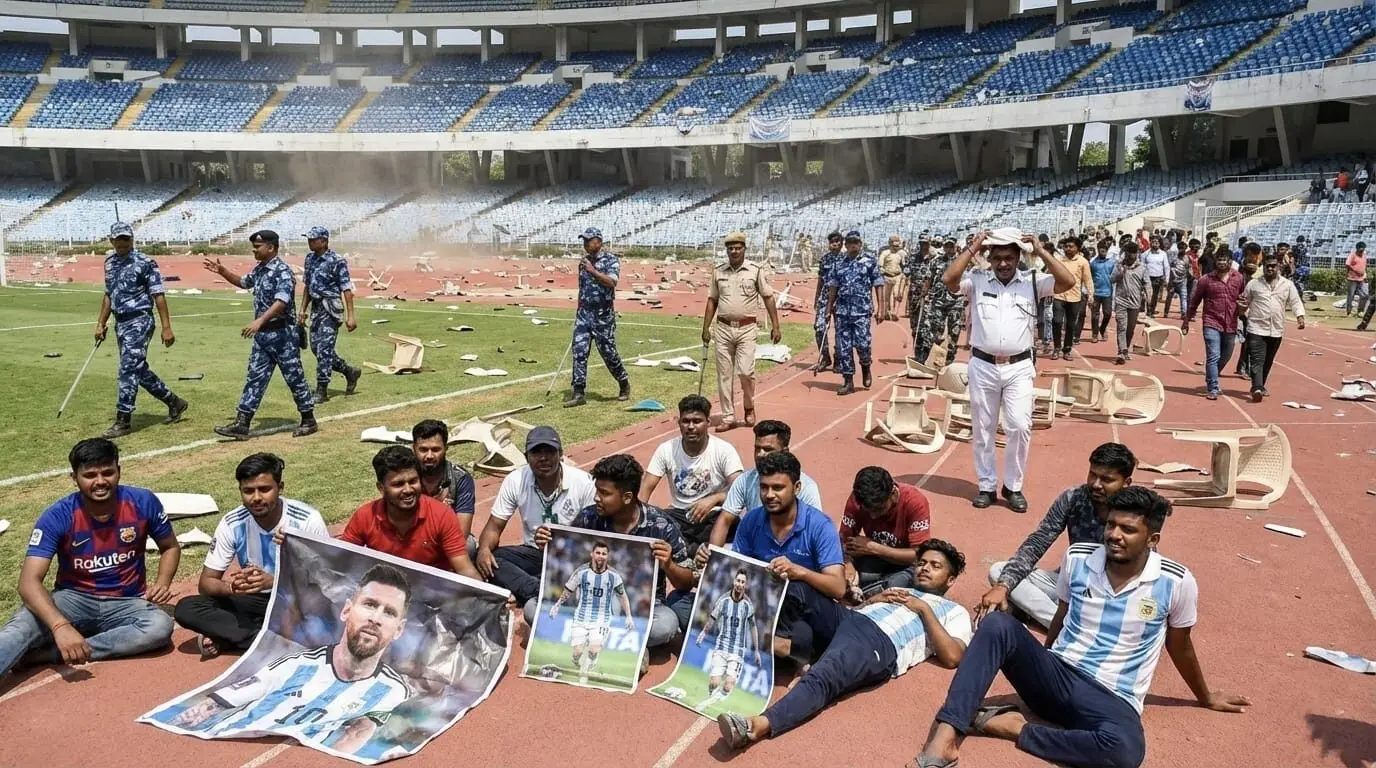
- Pitch Invasion: Hundreds of spectators blew right past the inadequate security fences and stormed the pitch. They were furious, shouting epithets at the organizers and demanding justice. It was a raw, visceral protest against being short-changed.
- Stadium Destruction: Debris and water bottles rained down onto the pitch. Then, in an act of furious symbolism, people started violently yanking out the fixed plastic seats from the galleries and chucking them onto the field. The stadium, a proud piece of city infrastructure, was trashed. The damage represented the shattered expectations of the fans.
The Lathi Charge: A Horrifying Spectacle
The police, completely outmatched by the sheer volume and justifiable rage of the crowd, had to resort to lathi charges (baton strikes) both inside and outside the venue to get things under control. It was a horrifying spectacle of chaos, a PR disaster broadcast live: fans who had come to celebrate their hero were being beaten by the police for protesting administrative greed and incompetence.
“We paid an arm and a leg to see Messi, not a politician’s selfie session,” one fan yelled to the media, his voice hoarse with emotion, perfectly summing up the universal feeling of disgust. “They treated us like dirt. We were promised an event; we got a 20-minute joke.” This quote became the headline for the entire debacle.
The Aftermath — Justice, Sort Of
The fallout was predictably swift and severe. The sheer scale of the international embarrassment—the footage of the riot was instantly global news—forced an immediate, panicked response from authorities.
The Political Fallout and Formal Apology
The state government, mortified by the spectacle, was quick to react. Chief Minister Mamata Banerjee publicly declared herself “appalled” by the mismanagement and swiftly issued a formal, contrite apology to Lionel Messi and, more importantly, to the citizens of Kolkata. A high-level enquiry was immediately commissioned to determine whose negligence had caused the fiasco. The political pressure was immense, as the government could not afford to look incompetent on such a high-profile, globally televised matter.
Organiser Gets Nabbed, Refunds Promised
In the most dramatic, movie-like turn of events, the main promoter of the event, Satadru Datta, was detained by police right at the airport as he was literally putting Messi and his entourage onto a plane bound for Hyderabad. The police confirmed the detention, citing “gross negligence and mismanagement of public expectations.” The detention sent a clear signal that the state was serious about accountability.
The crucial saving grace, a tiny consolation for the paying public, was the written assurance extracted from the detained organiser: full ticket money will be refunded to all who attended the disaster. While money cannot replace the lost opportunity or the sting of betrayal, it was a necessary first step towards restoring public trust.
A Long Shadow and A Damaged Reputation
Contrast this 2025 mess with the smooth, genuine, and successful 2011 friendly—a real football match with 85,000 electric fans. That event was about the game and the fans. This 2025 flop was purely about cashing in on a celebrity, and the event management failed spectacularly by prioritizing a handful of self-serving VVIPs over thousands of devoted, paying supporters.
The Kolkata leg of the GOAT Tour won’t be remembered for Leo Messi’s smile; it’ll be remembered as the event where the administrative ineptitude caused an absolute riot. The entire sorry episode, with its high prices, the infamous 22-minute walkout, the stadium wreckage, and the organiser’s detention, has put a big, ugly question mark over the city’s ability to host world-class events properly.
For the fans, the promised refund is good, but the bad taste of being short-changed by their own city’s administration—and having their own heroes blocked from view by greedy local officials—will linger for a very, very long time. It was a spectacular self-goal, and Kolkata deserves better.




1 thought on “What Went Wrong in Kolkata? Inside Lionel Messi’s GOAT India Tour 2025 Controversy That Rocked Fans”