We have all been there. It is Sunday night, and a sudden surge of inspiration hits. You decide that tomorrow is the day everything changes. You are going to wake up at 5:00 AM, run five miles, eat nothing but kale, and finally start that side business you have been talking about for three years. You are fired up. You are ready. You are “motivated.”
Then, Monday morning arrives. The alarm goes off, the room is cold, and suddenly, that mountain of ambition feels like a weight you aren’t ready to lift. By Wednesday, the old habits have crept back in. By Friday, the dream is deferred once again.
This cycle is the most common human experience when it comes to self-improvement. We fail not because we lack talent or desire, but because we misunderstand the fundamental nature of change. We try to overhaul our entire lives in a single weekend, forgetting that a skyscraper isn’t built in a day—it is built one brick at a time, often in the pouring rain, with no one watching.
The secret to moving the needle in your life isn’t found in grand gestures. It is found in the unsexy, quiet, and relentless commitment to getting just 1% better every single day. This is the “1% Rule,” and it is the only reliable way to achieve massive, long-term success.
Table of Contents
The Fallacy of the “Big Moment”
Our culture is obsessed with the “overnight success.” We see the highlight reels on social media: the finished body, the successful exit of a startup, the sold-out gallery. Because we only see the result, we subconsciously assume the process was just as explosive. We look for the “quantum leap”—that one lucky break or one Herculean effort that will bridge the gap between where we are and where we want to be.
But research into high performers—from Olympic athletes to world-class musicians—reveals a different reality. Success is rarely a sprint; it is an endurance race of incremental gains. When you focus on a “big moment,” you place an enormous amount of pressure on yourself. If that moment doesn’t happen quickly, you feel like a failure.
The 1% Rule flips this on its head. It suggests that your only job is to be slightly better today than you were yesterday. When you lower the bar for entry, you increase the likelihood of consistency. And in the world of personal development, consistency is the only currency that matters.

The Mathematics of the Compound Effect
To understand why 1% matters, we have to look at the math. This isn’t just a motivational phrase; it is a geometric reality.
Imagine you improve by just 1% every day for a year. Through the power of compounding, you don’t just become 365% better (which would be three and a half times better). Because each 1% gain builds on the previous day’s gain, the math looks like this:
1.01365 = 37.78
By the end of one year, you are nearly 38 times better than when you started.
Now, consider the alternative. If you get 1% worse every day—through procrastination, poor health choices, or mental stagnation—the math works against you:
0.99365 = 0.03
You essentially decline to almost zero. This is why small habits are a double-edged sword. A daily habit of reading 10 pages might seem insignificant on Day 5, but on Day 365, you’ve read 15 books. A daily habit of eating one extra sugary snack seems harmless today, but over a year, it’s the difference between health and chronic fatigue. Time magnifies whatever you feed it.
The Neuroscience of Why Small Wins Work
Why is it so much easier to commit to 1% than 100%? The answer lies in the architecture of the human brain.
1. Bypassing the Amygdala
Your brain is hardwired to keep you safe. Anything that represents a massive change—even a “good” change—is perceived by your amygdala (the brain’s fear center) as a threat. This is why “New Year’s Resolutions” often trigger a sense of anxiety or overwhelm. By aiming for a tiny, 1% change, you “sneak” past the amygdala. The change is so small that the brain doesn’t perceive it as a threat, allowing you to bypass the fight-or-flight response.
2. The Dopamine Loop
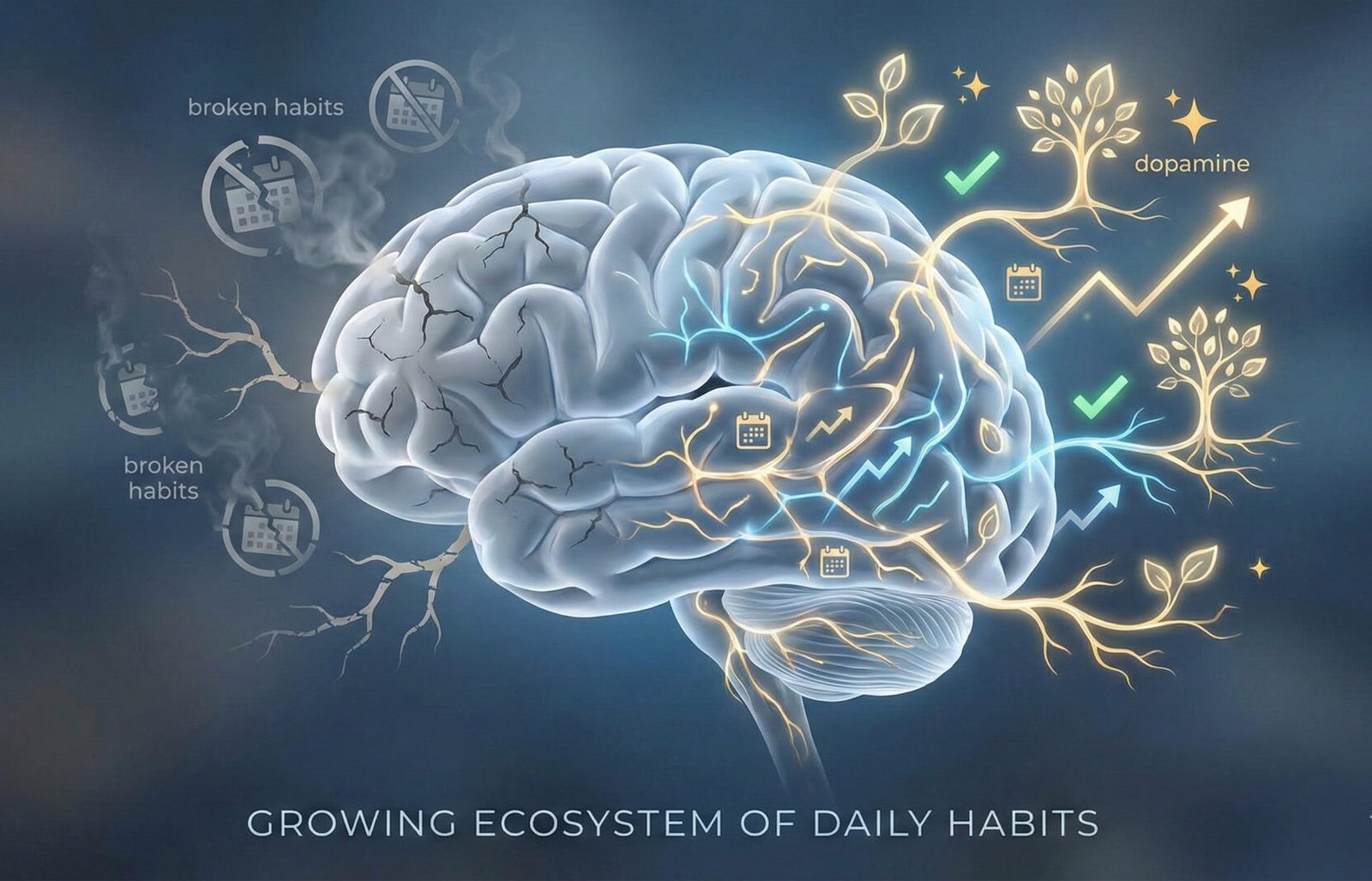
Our brains thrive on the reward molecule, dopamine. We get a hit of dopamine when we achieve a goal. If your goal is to “lose 50 pounds,” you might go months without a “hit,” leading to burnout. However, if your goal is to “walk for 10 minutes,” you get that dopamine reward every single day. This creates a positive feedback loop. You begin to associate “work” with “success,” which builds the neurological craving to repeat the behavior.
3. From the Prefrontal Cortex to the Basal Ganglia
New behaviors require conscious thought, which happens in the prefrontal cortex. This part of the brain is powerful but tires easily. This is why “willpower” is a finite resource. Through repetition, the 1% actions move to the basal ganglia, the part of the brain responsible for automatic habits. Once a behavior is stored here, it requires almost no energy to perform. You don’t “decide” to brush your teeth; you just do it. The goal of the 1% rule is to turn excellence into a default setting.
Surviving the “Valley of Disappointment”
One of the hardest parts of the 1% journey is what researchers call the Plateau of Latent Potential, or the “Valley of Disappointment.”
When you start a new habit, you expect your results to follow a linear path. You think, “If I work out for a month, I should look 1/12th better.” But progress is rarely linear; it is exponential. For the first few weeks or even months, you are doing the work, but the results are invisible. This is the Valley of Disappointment. You feel like you’re failing because you can’t see the compounding happening beneath the surface.
Think of an ice cube in a room that is -10 degrees. You heat the room to -9, -8, -5, -2. Nothing happens. The ice is still there. Then, you hit 1 degree. Suddenly, the ice melts.
Was it the one-degree shift that did it? No. It was all the previous work that led up to that threshold. Most people quit at -2 degrees. They quit just before the breakthrough because they lack the discipline to trust the process when the results are invisible.
Discipline vs. Motivation: The Great Debate
We often wait to “feel like it” before we take action. We wait for the “spark.” But motivation is a fickle friend. It is a feeling, and feelings change based on how much sleep you got, what you ate for lunch, or the weather outside.
Discipline is the ability to do the work regardless of how you feel. It is the realization that your goals do not care about your mood.
In the context of the 1% Rule, discipline is simply the commitment to the system rather than the goal.
- A goal is “I want to write a book.”
- A system is “I will write 200 words every morning at 7:00 AM.”
If you focus on the goal, you are in a state of “perpetual failure” until the book is finished. If you focus on the system, you are a success every time you sit down at 7:00 AM. Discipline becomes much easier when you stop judging the outcome and start valuing the effort.
The Identity Shift: Becoming the Person Who Succeeds
The most profound level of change doesn’t happen at the level of what you do, but who you are.
Many people try to change by focusing on outcome-based habits.
- ”I want to be thin” (Outcome).
- ”I want to be wealthy” (Outcome).
The problem is that if your internal identity doesn’t change, your old self will eventually sabotage your new results. To make the 1% Rule stick, you need identity-based habits.
Every action you take is a “vote” for the type of person you wish to become. When you choose to go to the gym on a day you don’t feel like it, you aren’t just burning calories; you are casting a vote for the identity of “I am a person who doesn’t miss workouts.” When you choose to save five dollars instead of buying a latte, you are voting for the identity of “I am financially disciplined.”
Over time, these votes accumulate. You stop trying to be disciplined and you simply become a disciplined person. Once the identity is locked in, the 1% gains happen naturally because they are an expression of who you are.
Environmental Design: Making 1% Easier
If you have to fight your environment every day, you will eventually lose. Human beings are “path of least resistance” creatures. To master the 1% Rule, you must curate your surroundings to support your goals.
Reduce Friction for Good Habits
If you want to exercise in the morning, lay your clothes out the night before. If you want to drink more water, put a bottle on your desk. The goal is to make the “right” choice require the least amount of willpower.
Increase Friction for Bad Habits
If you spend too much time on your phone, put it in a different room while you work. If you eat too much junk food, don’t keep it in the house. By adding just 20 seconds of “friction” to a bad habit, you drastically decrease the likelihood of doing it.
The Social Landscape of Change
As you begin your journey of 1% improvements, something interesting—and sometimes painful—happens. Your social circle will react.
When you start changing, you are essentially holding up a mirror to the people around you. If they are not growing, your progress might make them feel insecure or guilty about their own stagnation. They might try to pull you back down. They might call you “obsessed,” “boring,” or say “you’ve changed.”
This is the “Social Cost of Discipline.” To reach the top 1% of your field or your potential, you must be willing to be misunderstood by the other 99%.
True growth requires a certain level of healthy selfishness. You have to protect your time, your energy, and your focus. This doesn’t mean you stop caring about people, but it does mean you stop letting their comfort levels dictate your trajectory. As you get 1% better every day, you will eventually find a new “tribe” of people who are also on the 1% path.
Practical Steps: How to Start Your 1% Journey Today
You don’t need a complex planner or a lifestyle overhaul. You just need to pick one area of your life and apply these four steps:
1. The Two-Minute Rule
Whatever habit you want to build, scale it down until it takes less than two minutes.
- ”Read more” becomes “Read one page.”
- ”Meditate” becomes “Close your eyes for 60 seconds.”
- ”Clean the house” becomes “Fold one pair of socks.” Master the art of showing up before you worry about the intensity.
2. Habit Stacking
Identify a current habit you do every day (like brushing your teeth or making coffee) and “stack” your new 1% habit on top of it.
- ”After I pour my coffee, I will write my to-do list.”
- ”After I get into bed, I will think of one thing I’m grateful for.”
3. Track the Streak, Not the Result
Get a calendar and put a red ‘X’ on every day you complete your 1% task. Your only goal is to not break the chain. The visual representation of your progress is a powerful psychological motivator.
4. Never Miss Twice
Life happens. You will get sick, you will travel, and you will have “off” days. The rule is: Never miss twice. Missing once is an accident. Missing twice is the start of a new habit. If you fall off the wagon, get back on immediately.
The 2026 Perspective: Human Discipline in an AI World
As we move further into this decade, the value of human discipline is actually increasing. In an era where AI can generate content, code, and strategies in seconds, the “human edge” is no longer just about information—it is about implementation and character.
In 2026, anyone can use a tool to get an answer, but very few people have the mental toughness to stick to a physical fitness regime, a deep-work protocol, or a long-term skill-building process. Discipline is becoming a rare commodity. By committing to the 1% Rule, you aren’t just improving yourself; you are making yourself indispensable in a world that is increasingly distracted and looking for shortcuts.
Conclusion: The Power of Patience
We are often told that “life is short.” While that is true in a cosmic sense, life is also very long when it comes to the consequences of our daily choices.
The 1% Rule is a philosophy of patience. It is an admission that you don’t have all the answers yet, but you are willing to learn. It is the humility to start small and the courage to stay consistent.
Success is not a grand “event” that happens to you. It is a slow-motion process that you create. It is the result of the choice you make when the alarm goes off, the choice you make when you’re tired, and the choice you make when no one is watching.
Stop looking for the giant leap. Look for the next 1%. If you can find it, and if you can repeat it, your life will look unrecognizable a year from now. The “you” of next year is currently being built by the “you” of today. Make sure you’re giving them a solid foundation.