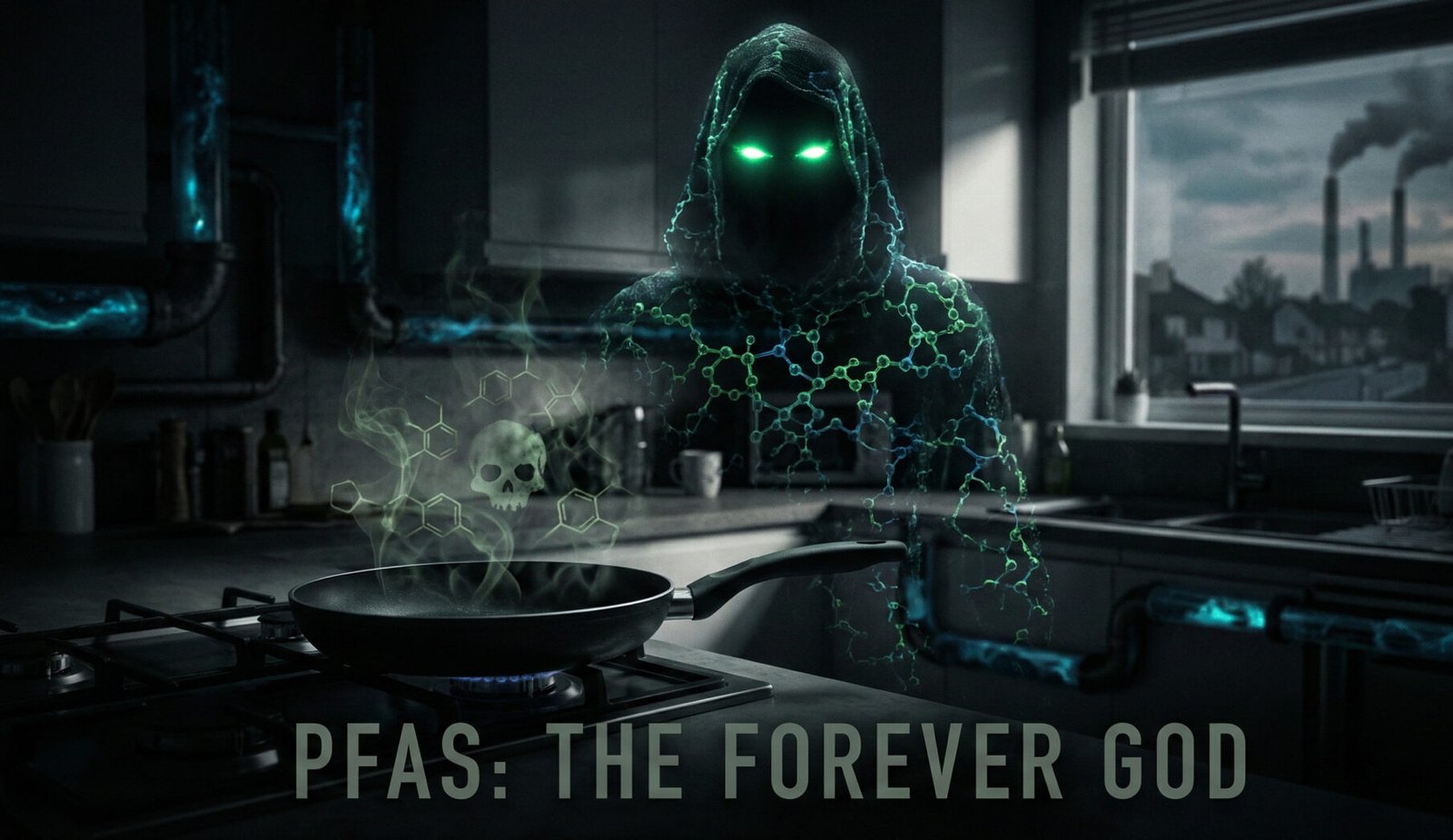
Imagine a villain with a superpower so absolute that not even time can defeat it. In the world of comic books, we might call this character an “Evil Superman.” In the world of chemistry, this entity actually exists. Its name is PFAS (Per- and polyfluoroalkyl substances).
Recently, environmental advocates and scientists have started using dramatic language to describe these chemicals—calling them the “evil gods” of the molecular world. Why? Because like a god, they are omnipresent (found in the blood of 99% of humans) and immortal (they do not break down in the environment).
But how did we get here? How did a “miracle” substance found in the 1930s become the most persistent threat of the 21st century? To understand the “evil god,” we have to look at its origin story.
Table of Contents
1. The “Happy Accident” of 1938
Every great villain needs an origin story, and for PFAS, it began with a mistake.
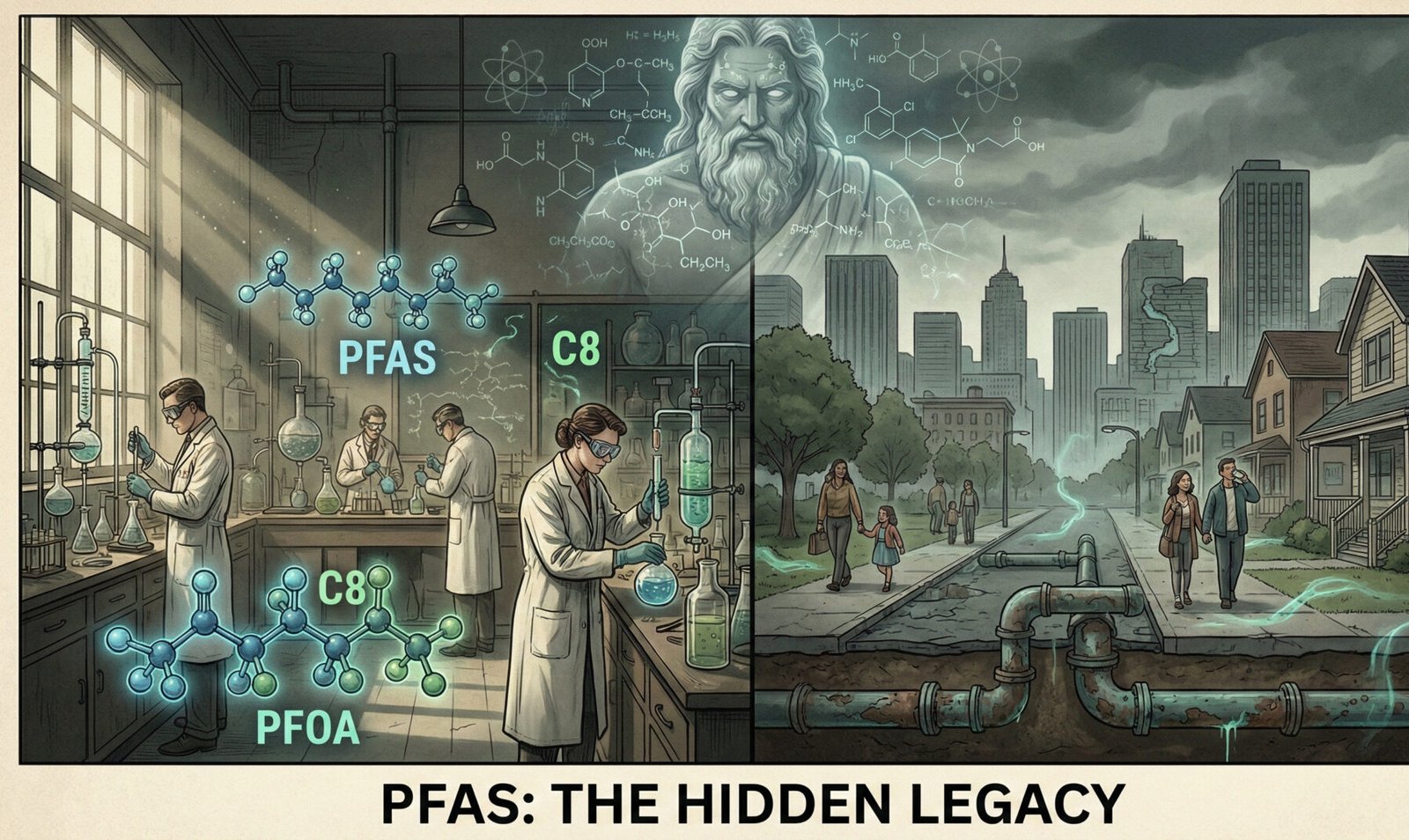
In April 1938, a young DuPont chemist named Roy Plunkett was working in a lab in New Jersey. He wasn’t trying to create a global contaminant; he was trying to invent a better refrigerant gas for refrigerators. He left a cylinder of tetrafluoroethylene gas in dry ice overnight. When he opened it the next morning, the gas was gone, replaced by a strange, white, waxy powder.
This powder was PTFE (Polytetrafluoroethylene), better known today by the brand name Teflon.
Plunkett discovered that this new substance was unlike anything else on Earth. It was incredibly slippery, it could withstand extreme heat, and it was “inert”—meaning almost no other chemical could react with it or break it down. At the time, it was hailed as a miracle. It was the “Superman” of materials: stronger, faster, and more resilient than anything nature had provided.
2. From the Manhattan Project to the Suburbs
Before Teflon became a household name for frying eggs, it had a much darker job. During World War II, the Manhattan Project (the secret mission to build the first atomic bomb) ran into a massive problem: they needed a way to handle highly corrosive uranium hexafluoride.
Nothing worked. The gas ate through pipes, seals, and gaskets—until they tried DuPont’s new “miracle” chemical. PFAS-based materials were the only things tough enough to survive the atomic process.
After the war, the chemical giants (specifically 3M and DuPont) realized that if this stuff could survive an atomic bomb, it could certainly survive a suburban kitchen. In the 1950s and 60s, PFAS exploded into the consumer market:
- Teflon: Non-stick pans meant no more scrubbing.
- Scotchgard: Created by 3M, this allowed furniture and carpets to repel stains.
- Firefighting Foams: PFAS became the gold standard for putting out jet fuel fires.
For decades, we lived in a “non-stick” dream. But behind the scenes, the “evil god” was starting to wake up.
3. Why They Are Called “Forever Chemicals”
To understand why the speaker in your video called PFAS an “evil Superman,” you have to understand the Carbon-Fluorine (C-F) bond.
In organic chemistry, the bond between a carbon atom and a fluorine atom is one of the strongest bonds ever discovered. It is so strong that natural processes—like bacteria, sunlight, or heat—simply cannot break it.
The Persistence Problem
Most things in nature rot, rust, or disappear. A leaf falls and becomes soil. A piece of iron eventually turns to dust. But PFAS molecules are like tiny suits of armor. When you wash a stain-resistant jacket or throw away a non-stick pan, those PFAS molecules don’t “die.” They wash into the soil, seep into the groundwater, and eventually enter the food chain.
This is why they are called “Forever Chemicals.” Once they are in the environment, they stay there. For centuries. Possibly forever.
Analogy: If a normal chemical is like a wooden house that eventually rots away, PFAS is like a house made of indestructible, radioactive diamonds. It’s not going anywhere.
4. The Hidden Knowledge: The Corporate “Cover-Up”
The most “evil” part of the PFAS story isn’t just the chemistry—it’s the history of what the manufacturers knew.
As early as the 1960s, internal studies at 3M and DuPont showed that PFAS chemicals were accumulating in the blood of laboratory animals and causing liver damage. By the 1970s, 3M realized that PFAS was building up in the blood of its own workers.
Instead of sounding the alarm, the industry kept quiet. They continued to pour millions of pounds of these chemicals into the environment. They marketed them as safe, even as their own scientists warned that the “Evil Superman” was escaping the lab.
The Parkersburg Turning Point
The world didn’t truly learn the truth until a lawyer named Rob Bilott took on DuPont on behalf of a cattle farmer in Parkersburg, West Virginia. The farmer’s cows were dying of mysterious ailments after drinking from a creek contaminated by DuPont’s PFOA (a type of PFAS) sludge.
This legal battle (immortalized in the movie Dark Waters) revealed decades of suppressed data. It led to the C8 Science Panel, one of the largest human health studies in history, which linked PFAS exposure to:
- Kidney and testicular cancer
- Thyroid disease
- High cholesterol
- Pregnancy-induced hypertension
- Immune system suppression
5. The Modern Crisis: An “Evil God” in Our Water
Today, we are living with the consequences of 80 years of chemical immortality. PFAS has been detected in the most remote corners of the globe—from the ice of Antarctica to the breast milk of mothers in the Arctic.
How We Are Exposed
You don’t have to live near a chemical plant to be “blessed” by this evil god. PFAS enters our bodies through:
- Drinking Water: Estimated to affect over 200 million Americans.
- Food Packaging: Grease-resistant burger wrappers and microwave popcorn bags.
- Household Dust: From carpets and furniture treated with stain-proofing.
- Personal Care Products: Waterproof mascara, dental floss, and shaving creams.
6. How to Protect Yourself: Defeating the “Evil Superman”
While we can’t completely avoid PFAS in a modern world, we can reduce our “body burden.” Think of it as putting up a shield against the “evil god.”
- Filter Your Water: Not all filters work. Look for high-quality Activated Carbon or Reverse Osmosis systems that are specifically certified to remove PFAS.
- Ditch the Non-Stick: If your Teflon pan is scratched, it’s releasing millions of microplastics and PFAS into your food. Switch to stainless steel, cast iron, or “ceramic-coated” (though check that the ceramic is PFAS-free).
- Avoid “Stain-Resistant” Treatments: Skip the optional Scotchgard on your new sofa.
- Check Your Labels: Avoid products with ingredients starting with “Perfluoro” or “Polyfluoro.”
7. The Future: A New Era of Regulation
The good news? The “Evil Superman” is finally being challenged.
In 2024 and 2025, the EPA (Environmental Protection Agency) introduced the first-ever legally enforceable limits for PFAS in drinking water. Governments around the world are moving to ban the entire class of chemicals.
However, because these are “forever chemicals,” the cleanup will take decades and billions of dollars. We are currently in the “Third Act” of the PFAS movie: the world has finally recognized the villain, and now we are trying to find a way to contain it.
Conclusion: Respect the Chemistry
The speaker in your video was right. PFAS is an “evil god.” It is a testament to human ingenuity and a warning about human hubris. We created a substance that was “too perfect” for the natural world, and now we must learn how to live with a chemical that simply refuses to die.
By staying informed and making conscious choices about the products we bring into our homes, we can slowly diminish the power this “evil god” holds over our health