
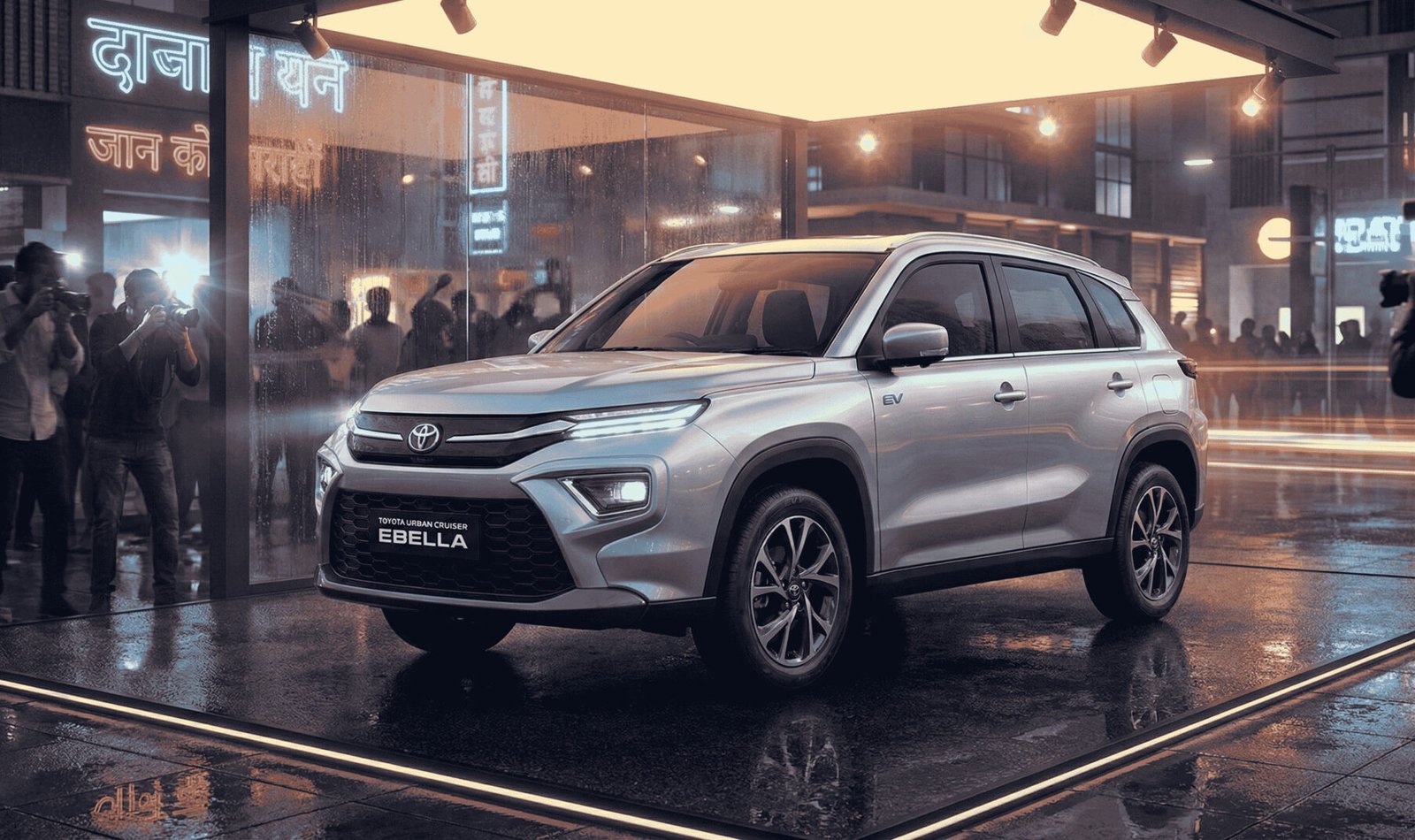
Toyota has officially taken a big step into India’s fast-heating electric SUV space with the toyota urban cruiser ebella launch, marking the brand’s first mainstream EV offering for the country. Revealed and opened for bookings on January 20, 2026, the urban cruiser ebella arrives as a badge-engineered sibling of the Maruti Suzuki e-Vitara—sharing core hardware and packaging—while wearing Toyota’s own styling touches and brand-backed ownership programs aimed at reducing EV anxiety.
With midsize electric SUVs quickly becoming the new battlefield, Toyota is positioning the toyota urban cruiser ev to compete against established and incoming rivals in the segment, including models like the Hyundai Creta Electric and others highlighted in early comparisons by auto publications.
Table of Contents
Bookings open, prices awaited: what we know so far
One of the biggest questions buyers have right now is pricing. While the full sticker hasn’t been formally detailed across all coverage, Toyota has started accepting bookings for the new electric SUV with a token amount at dealerships, signaling that deliveries and pricing announcements are expected soon.
This is also why searches around toyota urban cruiser ebella ev price are surging—because Toyota has revealed most of the vehicle story (battery, range, features), but is keeping the final “value equation” for the next update.
Two battery packs, up to 543km claimed range
The headline numbers are strong for a first outing. The toyota ebella will be offered with two battery options: a 49 kWh pack and a larger 61 kWh pack. Both versions use a single-motor setup for India, and Toyota is quoting a claimed range that stretches as high as 543 km (ARAI) with the bigger battery.
Here’s what reported specs indicate:
- 49 kWh: around 144 hp, 189 Nm, claimed ~440 km (ARAI)
- 61 kWh: around 174 hp, 189 Nm, claimed ~543 km (ARAI)
Toyota also highlights the use of LFP (Lithium Iron Phosphate) chemistry for these packs—often associated with durability and stability—helping the brand pitch long-term ownership confidence.
Charging support and India-spec drivetrain
Charging capability is another key pillar for any toyota urban cruiser ev buyer. Coverage notes support for both AC and DC fast charging, though exact peak charging rates can vary by variant and final spec sheet. Importantly, while some global versions may offer AWD, reports indicate the India-spec model is focused on a front-wheel-drive layout.
Design: Toyota identity on a shared EV platform
Even as a sibling to the e-Vitara, the toyota urban cruiser ebella is being presented with its own visual character—Toyota’s sharper fascia treatment, clean urban-SUV proportions, and EV-specific cues. Toyota’s official presentation emphasizes elements like its SUV stance, wheel design, and the “electric calm” driving experience the platform is meant to deliver.
The broad takeaway: Toyota wants the urban cruiser ebella to look premium and city-ready rather than experimental—an EV you can park next to popular ICE SUVs without it feeling like a niche product.
Cabin and features: safety + tech as the core selling point
This is where Toyota appears to be leaning hard into value perception. Reported highlights include a strong safety focus and an equipment list tuned for the Indian buyer who expects “big-car features” in a midsize SUV. Depending on variant, coverage mentions:
- Seven airbags
- Level-2 ADAS
- 360-degree camera
- Ventilated front seats
- Dual-screen dashboard layout
- Premium branded audio (JBL noted in reports)
- Rear seat comfort features like sliding/reclining
Toyota is expected to offer the EV in multiple trims—reported as E1, E2, and E3—which should create a pricing ladder once the official figures are announced.
Ownership programs: warranty, buyback, and Battery-as-a-Service
Beyond the product itself, Toyota is also trying to reduce EV hesitation through policy-led reassurance. Reports say Toyota is offering an 8-year battery warranty, an assured buyback program, and even a Battery-as-a-Service (BaaS) approach to help customers manage long-term costs. For many first-time EV buyers, these initiatives may matter nearly as much as range and charging.
Why this launch matters for India’s EV market
Toyota has long been associated with hybrids in India, and this is a notable pivot: the toyota urban cruiser ebella launch signals Toyota’s intention to play in the mainstream electric SUV segment rather than staying only in hybrid territory. It’s also strategically timed—midsize SUVs are where India’s high-volume personal car demand sits, and EV adoption is increasingly moving from “early adopters” to regular family buyers.
With a claimed 543km top range figure and a feature list stacked with ADAS and comfort tech, Toyota is clearly attempting a “no-compromise” pitch—especially for buyers cross-shopping a premium ICE SUV or a top-end hybrid.
The big question: final price positioning
Until Toyota publishes the official sticker, every conversation will keep circling back to toyota urban cruiser ebella. If Toyota lands aggressive pricing, the urban cruiser ebella could become a high-volume option; if it’s positioned too premium, it may remain a brand-building EV rather than a segment disruptor.
Either way, this launch is Toyota’s clearest statement yet: the era of Toyota EVs in India has begun—and the toyota urban cruiser ebella is the first chapter.




Nice